Austrian Garrison Negotiates Charleroi Surrender
Jacques Maurice Hatry
The besieged garrison entered capitulation negotiations as French pressure increased. The agreement deprived the approaching coalition of the fortress it intended to save.
June 1794 and the Sambre campaign. Explore the related historical entries from the same archive as the main French Revolution records.
The besieged garrison entered capitulation negotiations as French pressure increased. The agreement deprived the approaching coalition of the fortress it intended to save.
Saint Just oversaw the republican campaign as the Austrian garrison of Charleroi surrendered. The victory freed French troops to face the approaching coalition army.
Charleroi surrendered to the French on 25 June 1794 after the siege. The release of Hatry's troops strengthened Jourdan's position for the coming battle.
Saint Just was present with the republican command as Charleroi fell. The victory gave the Convention a military success before the larger engagement at Fleurus.
Jourdan could use troops no longer required to contain the garrison after its surrender. This allowed broader deployment against the advancing coalition army.
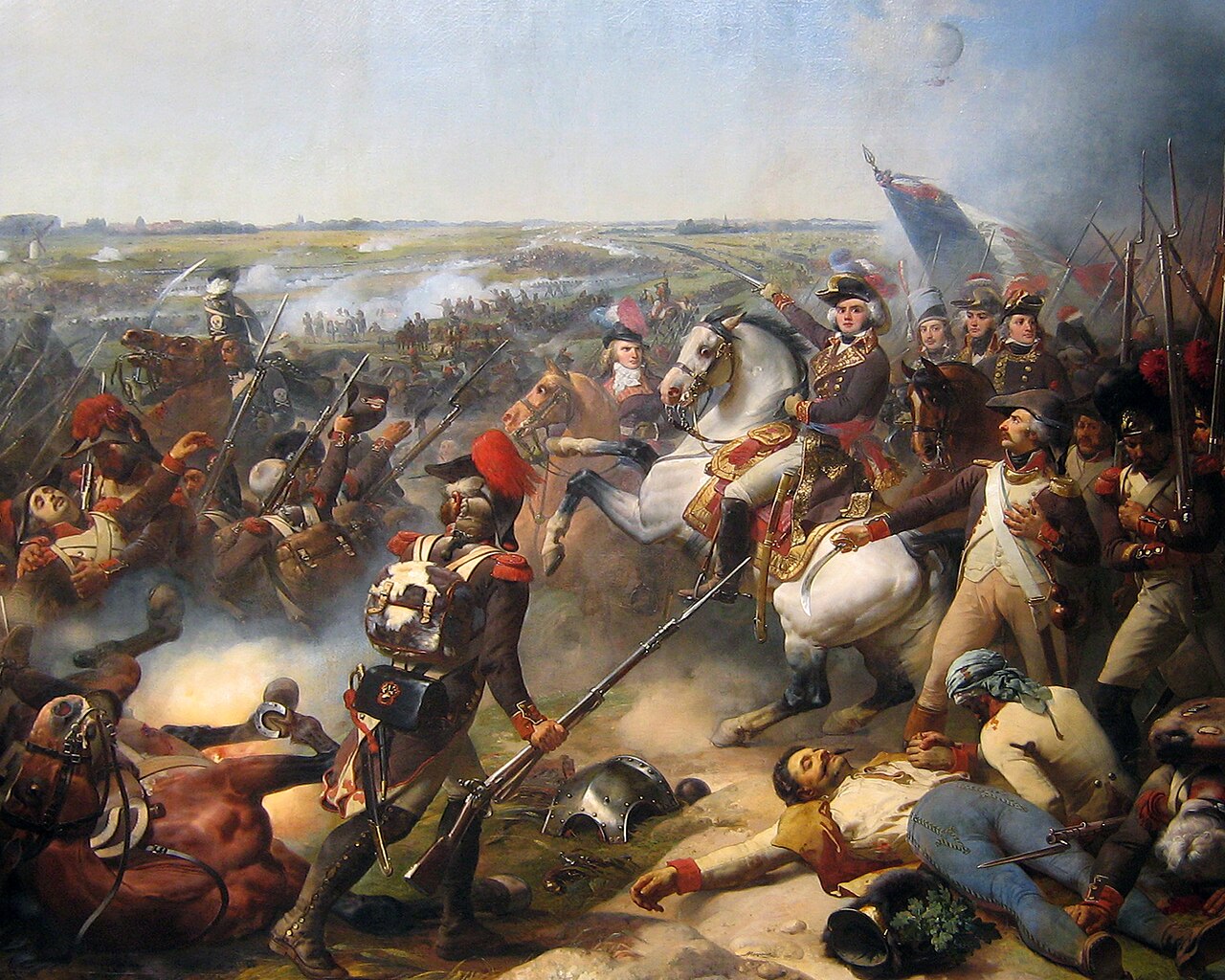
French aeronauts used the observation balloon Entreprenant during the Fleurus operation to observe enemy movements. This early military aviation experiment supplied information to commanders.
Championnet's troops occupied ground near Heppignies to protect the center of the French position. Their resistance helped preserve the line between Fleurus and Charleroi.
Jourdan met the coalition offensive near Fleurus only a day after Charleroi fell. French troops were forced to hold several threatened sectors simultaneously.
Coalition forces pressed French troops in the Gosselies area while Jourdan defended Charleroi. Morlot's sector experienced heavy pressure during the fighting.
Daurier's formation occupied the extreme French left near the Sambre. Control of this flank was important for keeping communications with the river crossings open.
Championnet resisted attacks east of Charleroi during the battle of Fleurus. The action helped deny the coalition a route into the captured fortress.
The battle stretched over several villages east and north of Charleroi while Jourdan shifted attention among threatened formations. Difficult communications made coordination especially demanding.
Jourdan defeated the coalition offensive that followed the fortress's capitulation. Charleroi remained in French hands and became a springboard into Belgium.
Jourdan defeated the coalition offensive near Fleurus after Charleroi fell. The outcome weakened the enemy position across the Austrian Netherlands.
Troops recently committed to the Charleroi siege were reassigned as reserves for the fighting at Fleurus. Hatry's formation illustrated the connection between the siege and the field engagement.
Despite withdrawals in some sectors Jourdan's army kept control of the approaches to captured Charleroi. The coalition failed to recover the fortress.
Jourdan's republican army defeated the coalition offensive near Fleurus on 26 June 1794. The victory accelerated France's reconquest of the Austrian Netherlands.
Kleber used troops near Jumet to reinforce the left sector as enemy pressure mounted. The maneuver helped maintain a defensible line around Charleroi.
The French line around Gosselies became a contested sector during the coalition offensive. Morlot's men had to absorb enemy pressure while other divisions fought across the front.
After Charleroi surrendered Hatry's division was available to support Jourdan's field army. Its deployment near Ransart gave the French another formation for emergencies.
Championnet organized resistance and local counterattacks near Heppignies. The action maintained contact between neighboring French divisions.
Kleber guarded the western approaches during the coalition attempt to reverse the French gains. His troops helped prevent an attack on communications with Charleroi.
Kleber redirected available forces as coalition columns pressed parts of the republican line. Flexible use of reserves helped avert a breakthrough.
Lefebvre's troops held their ground against coalition pressure near Lambusart. Their defense prevented the enemy from turning the French eastern flank.
Lefebvre's division resisted assaults in the Lambusart area during the daylong battle. Its stand helped protect the army's eastern approaches.
Lefebvre directed French forces near Lambusart against repeated coalition attacks. Holding this sector limited the enemy's ability to break into Jourdan's rear.
Marceau defended the right wing of Jourdan's deployment near Fleurus. The French maintained enough cohesion to secure the earlier capture of Charleroi.
Marceau confronted troops seeking to turn the French right wing. The struggle prevented the coalition from exploiting a vulnerable section of Jourdan's defense.
Montaigu's French troops guarded the Trazegnies sector northwest of Charleroi. Their exposed position faced the risk of being isolated by a coalition advance.
Morlot held positions around Gosselies on the French left center. Pressure in this sector required reinforcements as coalition columns advanced.
The use of a tethered observation balloon at Fleurus drew attention to new ways of gathering battlefield intelligence. Its tactical value remains debated but its symbolic significance was substantial.
Saint Just and other representatives on mission accompanied the northern army during its decisive engagement. Their presence linked battlefield victory to the authority of the Convention.
Jourdan arranged his army around Charleroi with forces positioned on both sides of the approaches from the east. The deployment responded to reports of a major coalition attack.
Hatry's former siege division took up reserve positions near Ransart for the Fleurus battle. Its availability strengthened the French right and center.
Republican advances during 1794 gradually undermined Coalition control of northern France. The wider success at Fleurus helped make continued occupation of isolated French fortresses difficult.
The success at Fleurus weakened the argument that an immediate invasion threatened the Republic and altered the political context of emergency rule.
Jourdan directed a major republican advance toward Charleroi while other French armies fought farther west. The coordinated operations forced the coalition to defend a wider front.
The June victory at Fleurus supported the French advance into Belgium and reflected the strategic system Carnot helped organize.
After Fleurus French troops occupied additional towns across Belgium as coalition forces withdrew. The advance consolidated the Republic's gains in the Low Countries.
Carnot's coordination of men and supplies supported French advances through the Austrian Netherlands after Fleurus.
French possession of Charleroi supported communications between the Sambre crossings and advancing armies. The victory had consequences beyond the immediate siege.
Championnet's troops formed part of the republican force maneuvering around Charleroi. Maintaining their sector was important for screening the siege against Austrian relief columns.
Championnet's formation helped protect the eastern side of Jourdan's advance after Fleurus. Maintaining this flank reduced the danger of a sudden Austrian counterattack.
The loss of Charleroi and defeat at Fleurus forced coalition forces to abandon positions across central Belgium. The operation changed the strategic balance of the Low Countries.
Reports from Charleroi and Fleurus indicated that concentrating French forces on the Sambre had succeeded. The government gained confidence in renewed offensive operations.
Jourdan's campaigning helped bring about Charleroi's surrender, setting conditions for the decisive clash at Fleurus.
A coalition army advanced in an attempt to relieve the Austrian garrison. Jourdan prepared his troops for a major field battle while siege operations continued.
Following the unsuccessful attack at Fleurus coalition forces withdrew rather than launch another attempt to relieve Charleroi. The retreat opened a route for French operations westward.
Saint Just and his fellow commissioners insisted that commanders sustain the attempt to cross the Sambre. Their involvement reflected the government's insistence on energetic action.
Jourdan arranged troops around the besieged fortress to prevent coalition relief. The army had to protect its investment while anticipating an enemy advance.
French victory at Fleurus strengthened the Republic's northern frontier and reduced immediate invasion fears. The battlefield result changed the diplomatic and military calculation of the First Coalition.
French forces won the Battle of Fleurus during Saint-Just's mission, helping secure the northern frontier and advance into the Austrian Netherlands.
Reports of victory at Fleurus reached the Convention while France remained under emergency government. Military success affected debates over the continuing need for wartime repression.
The French victory at Fleurus preceded the overthrow of Robespierre by about one month. The reduced threat of invasion became part of the changing context of revolutionary politics.
The French success at Fleurus undermined the coalition position in the Austrian Netherlands. Austrian leaders increasingly regarded sustained occupation of Belgium as impractical.
The republican army invested Charleroi during its June offensive into Belgium. Control of the fortress would secure an important crossing and base for further operations.
Carnot helped direct strategic resources toward the northern front as France sought to dislodge coalition troops. Coordinated pressure around the Sambre prepared the approach to Fleurus.
Holding Charleroi enabled republican forces to sustain operations across the Sambre. The fortress became an important logistical point for the advance into Belgium.
Kleber's formations participated in the wider advance after the coalition retreated from Fleurus. Charleroi no longer sat on an actively contested forward line.
Several French attempts to advance across the Sambre met stiff coalition resistance. Jourdan's command eventually renewed the effort with stronger concentration.
Jourdan defeated Coalition troops at Fleurus, a turning point that helped drive Austrian forces from the Belgian theatre.
Hatry directed forces assigned to the siege of Charleroi. His troops had to contain the garrison while Jourdan's field army guarded against outside intervention.
Championnet's troops stood near Heppignies east of Charleroi. Their position guarded a route by which coalition forces might disrupt the siege.
Jourdan assembled republican formations for an offensive toward the Sambre and Charleroi. Success required coordinating troops drawn from several armies.
Jourdan commanded forces fighting to cross the Sambre and secure positions against Austrian armies during the campaign in Belgium.
Kleber's formation occupied positions west and north of Charleroi during the final phase of the operation. This allowed siege troops to concentrate on the fortress.
Kleber controlled troops on the left of Jourdan's deployment during the Fleurus operation. His formation was positioned to meet enemy movements toward the Sambre crossings.
Kleber held major responsibilities in the French forces operating near Fleurus, where coordinated divisions contributed to the victory.
Kleber commanded an important part of the French army as it sought crossings toward Charleroi. River movements had to be protected against coalition counterattacks.
Lefebvre occupied ground near Lambusart to help secure French operations beyond the Sambre. The line became central to the defensive battle the next day.
With the coalition withdrawing Lefebvre's formation could move beyond its defensive positions at Lambusart. The shift from defense to advance altered the tempo of the northern campaign.
Lefebvre's command held positions east of Charleroi while other troops threatened the fortress. The deployment helped guard a vulnerable approach from the coalition army.
After Fleurus French formations on the left followed the retreating enemy. Pursuit was intended to stop coalition troops from establishing another defensive line.
Marceau's men participated in operations supporting the French move against Charleroi. The division helped protect the wider army during the advance.
Marceau's division held part of the French right during the fighting around Fleurus. His troops helped resist the coalition attempt to turn the republican flank.
Marceau helped cover the French right during the siege of Charleroi. His formation faced the possibility of an Austrian flanking movement.
Marceau's troops participated in the wider advance following the victory at Fleurus. French control spread into territory previously held by Austria.
Montaigu's division held ground northwest of the besieged fortress. Control of the sector protected communications across the Sambre.
Morlot commanded forces covering the approaches north of Charleroi. His position would become one of the sectors attacked at Fleurus.
Kleber's forces formed part of the continued pursuit after the Fleurus battle. Their operations contributed to the enemy's withdrawal from central Belgium.
Successes in Flanders and around Fleurus strengthened the Republic's strategic position. Carnot and the government could plan campaigns beyond immediate frontier defense.
Saint-Just was with representatives overseeing the Army of the North during the operations leading to Charleroi's surrender.
Saint Just's northern mission connected the siege victory to national revolutionary government. News from the front strengthened the Convention's sense that the military emergency was easing.
As French troops advanced after Fleurus the area immediately around Charleroi became less exposed. Marceau's participation in the campaign contributed to the more secure frontier.
French siege troops employed artillery against the fortified position at Charleroi. The bombardment increased pressure on the Austrian defenders as relief forces approached.
The retreat from Fleurus allowed republican armies to move toward Brussels. The campaign carried French authority deeper into the former Austrian Netherlands.
Saint Just accompanied the army during the Charleroi operation and supported a determined prosecution of the siege. Political pressure reinforced the military objective.
Jourdan concentrated formations from several republican armies into the Army of the Sambre and Meuse. Their combined strength allowed a renewed advance toward Charleroi.
The success at Fleurus vindicated the Republic's effort to concentrate manpower and materiel on the northern front. Carnot could redirect strategic planning toward deeper advances into Belgium.