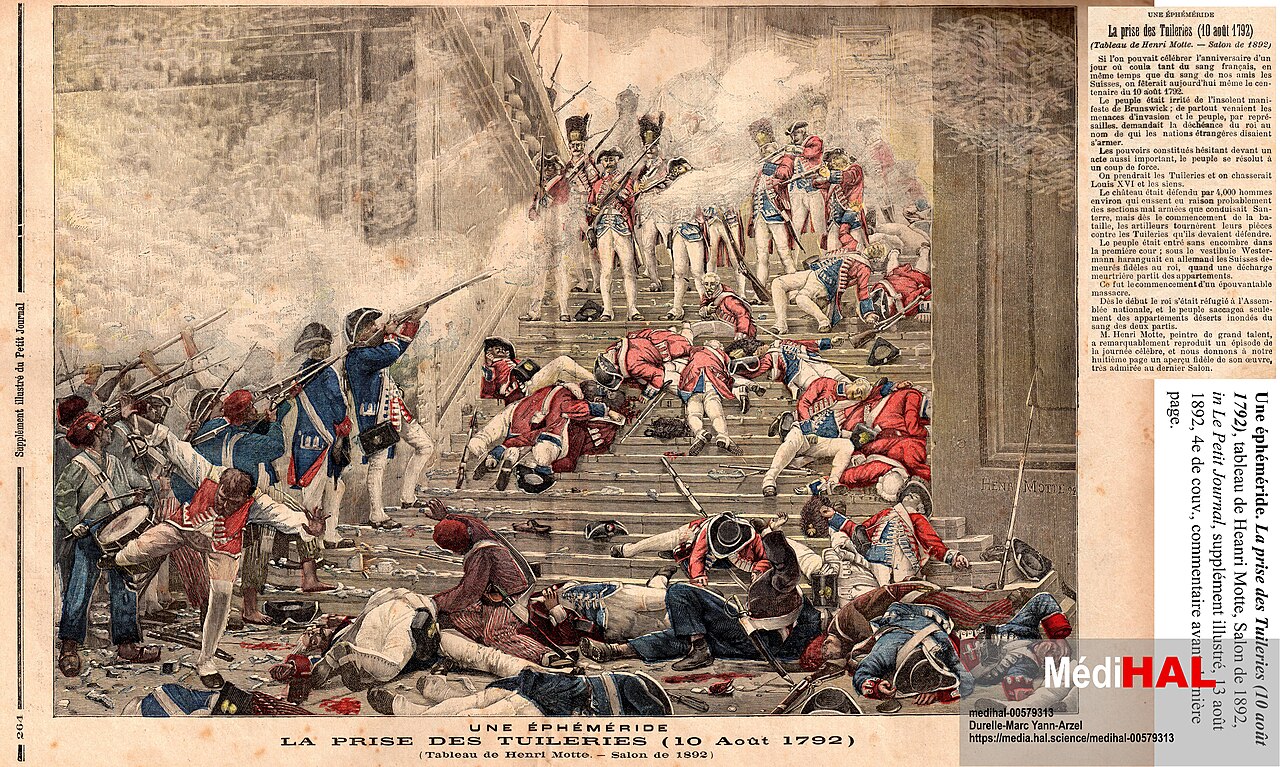
Insurrection and the overthrow of Louis XVI. Explore the related historical entries from the same archive as the main French Revolution records.
29 May 1792 · Tuileries Palace
Royal Guard disbanded by Assembly
Marie Antoinette
The Legislative Assembly ordered the dissolution of the king's Constitutional Guard amid accusations of royalist activity. Marie Antoinette saw another part of the household's security structure removed.
20 June 1792 · Tuileries Palace
Armed demonstrators enter Tuileries
Marie Antoinette
A crowd entered the royal residence and confronted Louis XVI over his policies. Marie Antoinette and the children endured the tense occupation as the monarchy's protection became less reliable.
20 June 1792 · Paris
Danton's milieu supports pressure on royal court
Georges Jacques Danton
Cordeliers activists helped sustain the climate of confrontation created by the royal vetoes and ministerial dismissals. The episode concerned armed petitioners enter the tuileries and affected the relationship between club activists and public authority.
20 June 1792 · Paris
Desmoulins denounces resistance by palace
Camille Desmoulins
Desmoulins's anti-court journalism reflected growing impatience with Louis XVI's use of constitutional powers. This aspect of armed petitioners enter the tuileries illustrates how press campaigns, popular sections and government decisions became connected.
20 June 1792 · Tuileries Palace
Guards confront 20 June palace demonstration
Antoine-Joseph Santerre
An armed procession entered the Tuileries to demand changes in royal policy. Santerre was associated with the popular movement that tested the guard's ability to maintain order.
20 June 1792 · Paris
June demonstration pressures royal authority
Jacques-Pierre Brissot
A large crowd entered the Tuileries after disputes over the king's vetoes and dismissed ministers. Brissot's political faction operated amid increasing reliance on demonstrations and sectional activism.
20 June 1792 · Tuileries Palace
Paris demonstrators confront the king: Deputies face street pressure
Pierre-Victurnien Vergniaud
Vergniaud's legislative milieu observed crowds entering the Tuileries to demand changes in royal policy. The protest revealed that constitutional procedures were no longer containing popular anger.
20 June 1792 · Tuileries Palace
Paris demonstrators confront the king: Dismissal grievance drives agitation
Jacques-Pierre Brissot
Brissot's followers continued challenging the court after the removal of Girondin ministers. Mass demonstrations increased pressure on a monarch whose vetoes had become politically explosive.
20 June 1792 · Tuileries Palace
Paris demonstrators confront the king: Ousted ministry remains a symbol
Jean-Marie Roland
Roland's dismissal was among the grievances voiced by opponents of the palace. The dispute illustrated how ministerial appointments had become a wider contest over revolutionary legitimacy.
20 June 1792 · Paris
Santerre represents militant faubourg mobilization
Antoine Joseph Santerre
Santerre's leadership of armed Parisian citizens illustrated the alliance between popular sections and radical political pressure. The controversy surrounding armed petitioners enter the tuileries influenced the changing balance among revolutionary factions.
20 June 1792 · Paris
Tuileries Crowd Crisis
Jerome Petion
As mayor of Paris, Petion tried to limit the crowd invasion of the Tuileries during the demonstration of 20 June.
June 1792 · Tuileries Palace
Royal vetoes fuel confrontation
Marie Antoinette
Louis XVI resisted measures concerning refractory priests and military encampments near Paris. Marie Antoinette supported the preservation of royal authority while crowds increasingly viewed the vetoes as obstruction.
9 August 1792 · Paris
Insurrectionary Commune formed
Francois Hanriot
Delegates from radical sections displaced the existing Paris municipal authority and established an insurrectionary Commune. The new body supplied the uprising with a rival political command center.
9 August 1792 · Paris
Insurrectionary Commune formed - Change of authority
Francois Hanriot
Francois Hanriot figured in events surrounding insurrectionary commune formed at Paris. The new body supplied the uprising with a rival political command center. Its immediate significance was to transfer authority away from the crown toward revolutionary institutions.
9 August 1792 · Paris
Sections prepare armed march
Antoine Joseph Santerre
Parisian section leaders organized armed citizens and fédérés for action against the Tuileries. Santerre emerged as a significant figure in the militant movement confronting the royal government.
10 August 1792 · Paris
Armed sections advance against Tuileries
Antoine-Joseph Santerre
Santerre was associated with revolutionary National Guard battalions that supported the overthrow of the monarchy. The insurrection exposed opposing political commitments within forces nominally charged with keeping order.
10 August 1792 · Paris
August insurrection ends constitutional monarchy
Jacques-Pierre Brissot
The assault on the Tuileries led to the king's suspension and opened the way to a republic. Brissot now had to operate in a revolution whose armed sections could challenge elected deputies.
10 August 1792 · Hotel de Ville
City Hall Issues Orders During Palace Fighting
Georges Huguenin
Huguenin's insurrectionary municipal organization issued instructions as armed citizens fought at the Tuileries. The revolutionary Commune claimed direct authority from the Paris sections.
10 August 1792 · Paris
Commune and municipal leadership divided
Jerome Petion
Pétion's formal position as mayor was overtaken by the insurrectionary Commune's rise to power. The conflict exposed the breakdown of the previous municipal chain of command.
10 August 1792 · Tuileries Palace
Danton gains authority after palace uprising
Georges Jacques Danton
Danton's standing increased as the revolutionary coalition defeated forces defending the Tuileries. The episode concerned august insurrection topples monarchy and affected the relationship between club activists and public authority.
10 August 1792 · Tuileries Palace
Desmoulins supports overthrow of royal government
Camille Desmoulins
Desmoulins celebrated the revolutionary victory that ended Louis XVI's effective rule. This aspect of august insurrection topples monarchy illustrates how press campaigns, popular sections and government decisions became connected.
10 August 1792 · Paris
Exile
Lafayette
The Tuileries is stormed by the Paris mob, Lafayette surrenders to Austria.
10 August 1792 · Hotel de Ville
Existing Municipality Loses Effective Control
Jerome Petion
The insurrectionary Commune displaced the authority of established city officials during the August crisis. Petion remained a prominent figure but could not control the newly mobilized armed sections.
10 August 1792 · Paris
Insurgents converge on palace
Antoine Joseph Santerre
Armed citizens and provincial volunteers advanced toward the Tuileries in the early hours of 10 August. Santerre was associated with the forces challenging the king's constitutional government.
10 August 1792 · Paris
Insurrection
Jean Paul Marat
The fall of the monarchy after the insurrection of 10 August strengthens radical clubs and sections in Paris.
10 August 1792 · Hotel de Ville
Insurrectionary Municipality Forms at City Hall
Georges Huguenin
Delegates from the sections established an insurrectionary Commune at the Hotel de Ville during the attack on the Tuileries. Georges Huguenin became a leading figure in the new authority.
10 August 1792 · Paris
King crosses to the Assembly
Louis Auguste Bourbon
Louis XVI left the Tuileries with his family and placed himself under the protection of the Legislative Assembly. The move occurred while armed groups prepared to fight for control of the palace.
10 August 1792 · Paris
Mandat killed during August uprising
Jean-Antoine Mandat
Mandat was killed after his detention during the insurrection of 10 August. His death undermined the coherence of the National Guard formations defending the royal palace.
10 August 1792 · Paris
Mandat summoned to City Hall
Jean Antoine Mandat
Mandat left the Tuileries to answer a summons from the revolutionary municipal authorities at the Hôtel de Ville. His removal deprived the palace defenders of their commander at a crucial moment.
10 August 1792 · Hotel de Ville
Mandat summoned to insurrectionary city hall
Jean-Antoine Mandat
Mandat was called away from the Tuileries by the revolutionary municipal authorities. The palace garrison lost a central commander just as insurgent forces assembled.
10 August 1792 · Paris
Minister of Justice
Georges Jacques Danton
Danton became minister of justice after the overthrow of the monarchy during the August insurrection.
10 August 1792 · Paris
National Guards Divide during Palace Crisis
Antoine-Joseph Santerre
Units assigned to defend the Tuileries faced conflicting loyalties when the August insurrection began. Santerre and other militants backed the revolutionary movement rather than the palace command.
10 August 1792 · Hotel de Ville
Palace Guard Commander Summoned Before Commune
Jean Antoine Mandat
Jean Antoine Mandat was summoned from the Tuileries to city hall by insurgent authorities during the August uprising. His removal disrupted efforts to defend the palace.
10 August 1792 · Paris
Queen leaves threatened palace
Marie Antoinette
Marie Antoinette accompanied the king and their children to the Assembly as the Tuileries defenses collapsed politically. Her departure marked the royal family's loss of control over its own residence.
10 August 1792 · Paris
Roederer urges royal withdrawal
Pierre Louis Roederer
Roederer advised Louis XVI that remaining inside the Tuileries was unsafe and urged the family to seek refuge with the Assembly. The decision to leave the palace decisively undermined the royalist defense.
10 August 1792 · Paris
Royal monarchy overthrown: Assembly responds to insurrection
Pierre-Victurnien Vergniaud
Vergniaud was a leading member of the legislature during the overthrow of the Tuileries monarchy. Deputies faced the challenge of establishing lawful authority amid armed upheaval.
10 August 1792 · Paris
Royalist order collapses
Jacques Antoine Marie de Cazales
The storming of the Tuileries destroyed the practical basis for continuing Louis XVI's constitutional rule. Former supporters of the crown faced a transformed political landscape dominated by armed revolutionary forces.
10 August 1792 · Tuileries Palace
Santerre linked to decisive Paris mobilization
Antoine Joseph Santerre
The armed movement associated with Santerre helped secure the radical sections' victory over the royal establishment. The controversy surrounding august insurrection topples monarchy influenced the changing balance among revolutionary factions.
10 August 1792 · Paris
Swiss Guard resists attackers
Karl Josef Bachmann
The Swiss Guards stationed at the palace fought insurgents during the assault on the Tuileries. Bachmann was among the officers associated with the royal military defense, which suffered severe losses.
10 August 1792 · Paris
Tuileries Insurrection Observed
Napoleon I
Napoleon witnessed the revolutionary crisis surrounding the assault on the Tuileries while he was in Paris.
10 August 1792 · Tuileries Palace
Tuileries Palace attacked
Marie Antoinette
Insurgents attacked the Tuileries while royal defenders, including Swiss Guards, fought to hold the palace. Marie Antoinette accompanied her family to seek refuge with the Legislative Assembly.
12 August 1792 · Paris
Marat presses revolutionary vigilance
Jean-Paul Marat
Marat's journalism pressed for vigilance against suspected royalist and counterrevolutionary threats after the fall of the Tuileries. This rhetoric contributed to the polarized atmosphere of the new emergency government.
17 August 1792 · Paris
Extraordinary tribunal established
Maximilien Robespierre
An extraordinary criminal tribunal was established to prosecute crimes connected with the events of 10 August. Revolutionary leaders argued that exceptional judicial mechanisms were required to secure the new order.
19 August 1792 · Paris
Lafayette leaves French army
Gilbert du Motier Lafayette
Lafayette abandoned his command and fled after the fall of the monarchy made his constitutional position untenable. His departure highlighted the rupture between the Revolution's earlier moderate leadership and the new regime.
August 1792 · Paris
Insurrectionary sections threaten monarchy
Marie Antoinette
Armed Parisian sections intensified preparations to depose Louis XVI as military and political crises worsened. Marie Antoinette faced the prospect that the Tuileries could no longer be held against a coordinated uprising.
August 1792 · Tuileries Palace
Mandat organizes Tuileries defense
Jean-Antoine Mandat
National Guard commander Jean-Antoine Mandat coordinated measures to protect the royal residence. His preparations faced serious obstacles as loyalties within Paris's armed forces fractured.
September 1792 · Paris
August legislation faces republican revision
Bertrand Barere
The fall of the monarchy reopened legislative debates about payments owed to former seigneurial lords. Convention deputies considered whether earlier compensation requirements contradicted republican liberty.
September 1792 · Paris
Girondin Alignment
Olympe Gouges
Olympe de Gouges aligned herself with moderate Girondin politics after the fall of the monarchy.
September 1792 · Paris
Mountain emerges in Convention: New republic brings factional choices
Georges Jacques Danton
Danton entered the Convention after helping the overthrow of the monarchy. He navigated alliances among radical deputies without belonging to a rigidly organized modern political party.
November 1792 · Paris
Trial of former king debated: King treated as public enemy
Louis-Antoine de Saint-Just
Saint-Just argued that Louis XVI ought to be treated as an enemy of the people rather than an ordinary litigant. His speech rejected the notion that royal inviolability survived the overthrow of monarchy.
1792 · Paris
August uprising brings Desmoulins into victorious camp
Camille Desmoulins
The insurrection of 10 August removed the king from effective power. Desmoulins's long campaign against the monarchy placed him among writers identified with the triumph of the radicals.
1792 · Paris
Commune revolutionary authority supports assault on palace
Georges Jacques Danton
The insurrectionary municipality backed the action that brought down the Tuileries on 10 August. Danton's influence linked the new city government with the revolutionary ministry formed afterward.
1792 · Paris
Demonstrators Press the King on Twenty June
Jerome Petion
Petion faced a major Parisian demonstration when crowds invaded the Tuileries and demanded that Louis XVI retreat from his vetoes.
1792 · Paris
Hébert embraces collapse of monarchy
Jacques Rene Hebert
Hébert's attacks on Louis XVI became sharper during the crisis preceding 10 August. The monarchy's overthrow enlarged the audience for militant republican journalism.
1792 · Paris
Insurrection Erupts on Ten August
Pierre Victurnien Vergniaud
Vergniaud participated in the legislature's emergency deliberations as insurgents attacked the Tuileries and the constitutional monarchy collapsed.
1792 · Hotel de Ville
Jacobin Leaders Join Insurrectionary Commune
Maximilien Francois Marie Robespierre
Robespierre participated in Parisian municipal politics during the period following the overthrow of the monarchy. The Commune connected neighborhood radicals to national revolutionary decision making.
1792 · Tuileries Palace
June demonstration enters the Tuileries
Jerome Petion
During the demonstration of 20 June, large crowds pressed into the royal palace. Pétion's municipal government faced criticism for failing to prevent direct pressure on the king.
1792 · Paris
Justice ministry appointment
Georges Jacques Danton
On 10 August Danton became minister of justice, entering the provisional executive established amid the collapse of the monarchy.
1792 · Paris
King Faces Protesters inside the Tuileries
Louis Auguste Bourbon
Louis XVI encountered crowds demanding changes in policy during the June demonstration, exposing the monarchy's increasingly insecure position.
1792 · Northern France
Lafayette's Command Unravels After August Rising
Gilbert du Motier Lafayette
The fall of the monarchy destroyed Lafayette's political position, and his attempted flight ended in detention by Austrian forces.
1792 · Paris
Municipal prosecutor backs revolutionary transfer of power
Pierre Louis Manuel
Pierre Louis Manuel served in the municipal leadership during the overthrow of the monarchy. His office helped connect section representatives to the emergent insurrectionary administration.
1792 · Paris
Robespierre joins insurrectionary municipal politics
Maximilien Robespierre
Robespierre took part in the politics of the revolutionary Commune after 10 August. His association with Paris sections helped build his influence before election to the Convention.
1792 · Hôtel de Ville
Section commissioners constitute insurrectionary Commune
Georges Huguenin
Commissioners chosen by Paris sections assembled overnight on 9–10 August and displaced the existing municipal council. Georges Huguenin presided over the new insurgent authority.
1792 · Paris
Tuileries Palace overthrow
Georges Jacques Danton
The insurrection of 10 August brought down royal authority, and Danton emerged as one of the influential political figures of the new regime.