President of National Assembly
Alexandre de Beauharnais
Beauharnais became president of the National Assembly during the crisis created by the royal flight.
The royal family’s attempted escape. Explore the related historical entries from the same archive as the main French Revolution records.
Beauharnais became president of the National Assembly during the crisis created by the royal flight.
Madame Elisabeth accompanies Louis XVI and Marie Antoinette during the escape attempt.
Accompanies Louis XVI and Marie Antoinette during the escape attempt.
Bouille prepares loyal troops near Montmedy as the intended military support for Louis XVI.
Prepares loyal troops near Montmedy as intended support for Louis XVI.
Lafayette commands the National Guard responsible for watching the royal family at the Tuileries.
Commands the National Guard responsible for watching the royal family at the Tuileries.
Axel von Fersen helps organise the escape and provides practical support for the royal family.
Hans Axel Fersen Count Fersen helped organize the royal family's escape from Paris.
Fersen drives or escorts the first stage of the flight before separating from the royal party near Bondy.
Louis Auguste Bourbon Louis XVI left the Tuileries Palace during the night escape toward the eastern frontier.
Louis XVI leaves the Tuileries Palace during the night escape toward the eastern frontier.
Breteuil supports the royal plan and expects foreign and royalist backing if the king reaches safety.
Louis Auguste Le Tonnelier Breteuil Baron de Breteuil supported the royal escape plan and expects foreign and royalist backing if the king reaches safety.
Louis Charles is taken from the Tuileries as part of the royal family escape party.
Taken from the Tuileries as part of the royal family's escape party.
Madame de Tourzel travels in disguise as Baroness de Korff to protect the royal children.
Travels in disguise as Baroness de Korff with the royal children.
Marie Antoinette leaves Paris with the royal family during the attempted escape.
Marie Antoinette Queen of France left Paris with the royal family during the attempted escape.
Marie Therese Charlotte travels with her parents during the failed royal flight.
Travels with her parents during the failed royal flight.
The royal family's flight revealed security failures at the Tuileries while Lafayette commanded the Paris Guard. The disappearance placed the constitutional monarchist general under intense public criticism.
Madame Elisabeth accompanied her brother Louis XVI on the clandestine journey out of Paris. Her presence made the attempted escape a family undertaking rather than the flight of the king alone.
Elisabeth Philippine Marie Helene Bourbon figured in events surrounding princess accompanies the king at Paris. Her presence made the attempted escape a family undertaking rather than the flight of the king alone. The crisis intensified the divide between constitutional monarchists and activists who doubted that the king could be trusted.
Marie Antoinette left the Tuileries under cover of darkness as part of the carefully planned royal escape. Her participation was essential because the king intended to move the family together.
Marie Antoinette figured in events surrounding queen joins departure in disguise at Paris. Her participation was essential because the king intended to move the family together. The incident revealed how policing, local officials and transport delays could defeat the royal escape plan.
Louis XVI made preparations to leave the Tuileries secretly with his family and reach forces near the eastern frontier. He hoped to regain political freedom from constraints imposed by the Revolution.
Louis Auguste Bourbon figured in events surrounding royal escape arrangements completed at Paris. He hoped to regain political freedom from constraints imposed by the Revolution. The episode undermined confidence in the possibility of governing France through a constitutional monarch who had tried to leave the capital.
The governess Madame de Tourzel traveled under the identity of Baroness de Korff in the royal escape party. This disguise helped provide a plausible explanation for the presence of several children and attendants.
Argues that the king's flight exposes a grave crisis of trust in the monarchy.
Madame Elisabeth is held with the royal family in Varennes after recognition of the king.
Sauce receives the detained travellers in Varennes while local officials decide whether they are the royal family.
Louis XVI is stopped at Varennes before reaching the royalist troops near Montmedy.
Stopped at Varennes before reaching the royalist troops near Montmedy.
Commands the escort that takes Louis XVI from Paris to Varennes.
Madame de Tourzel is detained with the children after the false Baroness de Korff identity fails.
Marie Antoinette is detained with the royal family after the escape fails at Varennes.
The discovery that Louis XVI had fled the Tuileries caused an immediate security crisis in Paris. Bailly's city government confronted public anger and fresh doubts about the constitutional monarchy.
General Bouille had prepared military support in the eastern frontier region for the king's arrival. Detention at Varennes kept the royal family from reaching those forces.
Francois Claude Amour Bouille figured in events surrounding bouille's frontier plans collapse at Montmedy. Detention at Varennes kept the royal family from reaching those forces. The incident revealed how policing, local officials and transport delays could defeat the royal escape plan.
News of the royal family's attempted escape prompted municipal authorities to arrange security and coordinate with the National Guard. The failure at Varennes placed the constitutional municipality under renewed political pressure.
Danton and fellow radicals intensified scrutiny of Louis XVI once his secret flight became known. The episode concerned varennes flight destroys royal confidence and affected the relationship between club activists and public authority.
Desmoulins argued in the radical press that the king's attempted escape undermined trust in constitutional promises. This aspect of varennes flight destroys royal confidence illustrates how press campaigns, popular sections and government decisions became connected.
Jacques Destez, who had previously encountered the king, helped confirm the identity of the traveler held at Varennes. Identification destroyed the possibility of treating the royal coach as an ordinary private party.
Jacques Destez figured in events surrounding destez identifies louis xvi at Varennes. Identification destroyed the possibility of treating the royal coach as an ordinary private party. The episode undermined confidence in the possibility of governing France through a constitutional monarch who had tried to leave the capital.
Held with the royal family in Varennes after recognition of the king.
Sauce keeps the royal party under local supervision while messengers and guards gather in the town.
Keeps the royal party under local supervision while guards and messengers gather.
Louis Charles is kept with the royal family while officials arrange the return to Paris.
Detained with the royal family after recognition at Varennes.
Detained with the royal children after the escape fails.
Detained with the royal family after the escape fails at Varennes.
Marie Therese Charlotte witnesses the detention of the royal family at Varennes.
Postmaster Jean-Baptiste Drouet became suspicious that the travelers passing through Sainte-Menehould included Louis XVI. His suspicion became critical when he decided to pursue the carriage toward Varennes.
Jean-Baptiste Drouet figured in events surrounding drouet becomes suspicious at Sainte-Menehould. His suspicion became critical when he decided to pursue the carriage toward Varennes. The episode undermined confidence in the possibility of governing France through a constitutional monarch who had tried to leave the capital.
Drouet set off toward Varennes to warn local inhabitants about the suspected presence of the king. His pursuit helped turn a passing suspicion into an organized interception.
Jean-Baptiste Drouet figured in events surrounding drouet rides toward varennes at Sainte-Menehould. His pursuit helped turn a passing suspicion into an organized interception. The incident revealed how policing, local officials and transport delays could defeat the royal escape plan.
Hans Axel Fersen figured in events surrounding fersen separates at bondy at Bondy. Responsibility for the rest of the journey passed to the party and its arranged escorts. The incident revealed how policing, local officials and transport delays could defeat the royal escape plan.
Bouille expects the royal family to reach the frontier but the escape collapses before his forces can help.
Bailly faces a political emergency in Paris after news spreads that the king has disappeared.
Louis XVI continues the journey eastward after the first carriage arrangements are completed outside Paris.
Marie Antoinette remains with the heavy coach despite the danger that the slow vehicle will delay the escape.
After the kings flight to Varennes Robespierre and other Jacobins question the future of constitutional monarchy.
Parisian National Guards were called upon to maintain calm after news that Louis XVI had fled. Their duties became politically fraught because the institution was associated with protecting the monarchy.
Jacques Destez is called because he had known the king at Versailles and confirms Louis XVIs identity.
Confirms the king's identity at Varennes after being summoned by local officials.
Louis XVI was prevented from continuing toward Montmedy after the authorities recognized him. His detention turned a secret royal journey into a constitutional emergency in Paris.
Louis Auguste Bourbon figured in events surrounding king detained in varennes at Varennes. His detention turned a secret royal journey into a constitutional emergency in Paris. Public knowledge of the failed journey encouraged both republican criticism and efforts to defend the remaining monarchy.
Marat used the flight to intensify his claims that court intrigues endangered revolutionary gains. The controversy surrounding varennes flight destroys royal confidence influenced the changing balance among revolutionary factions.
Drouet rides ahead to warn Varennes and prevent the royal party from continuing toward Montmedy.
Rides ahead to warn Varennes and stop the royal party.
Marie Antoinette stayed with the detained royal party while Varennes officials confirmed their identities and awaited instructions. The family's inability to proceed exposed the monarchy to public humiliation.
The failed flight to Varennes led Jacobin members to reassess the king's reliability. Robespierre questioned whether constitutional monarchy could survive the breach of trust.
Sauce accommodated and supervised the detained travelers while their identity was investigated. The local response prevented an immediate continuation toward Bouille's troops.
Jean-Baptiste Sauce figured in events surrounding royal party brought into town at Varennes. The local response prevented an immediate continuation toward Bouille's troops. The crisis intensified the divide between constitutional monarchists and activists who doubted that the king could be trusted.
Local officials and armed citizens stopped the royal travelers at Varennes before they could reach the intended military refuge. Marie Antoinette faced the collapse of the escape plan and immediate loss of control over the family's movements.
Madame de Tourzel remained with the royal children after the travelers were detained at Varennes. The exposure of the false Baroness de Korff identity undermined the arrangements designed to conceal the family's movement.
Louise Elisabeth Tourzel figured in events surrounding tourzel detained with children at Varennes. The exposure of the false Baroness de Korff identity undermined the arrangements designed to conceal the family's movement. It left Louis XVI and his relatives subject to closer political supervision and damaged the prestige of the court.
Residents and local officials stopped the royal travelers before they could continue through Varennes. Municipal officer Sauce became involved in overseeing the situation once the party was halted.
Jean-Baptiste Sauce figured in events surrounding varennes barricade stops carriage at Varennes. Municipal officer Sauce became involved in overseeing the situation once the party was halted. It left Louis XVI and his relatives subject to closer political supervision and damaged the prestige of the court.
Robespierre criticized the danger posed by a king who had attempted to leave France during the constitutional experiment. He approached the dispute as a test of popular sovereignty and the accountability of public power.
Brissot used political writing after Varennes to challenge the assumption that the king should automatically resume office. The unresolved legitimacy of the crown provided a backdrop for later demonstrations at the Champ de Mars.
Danton's Cordeliers milieu treated news of the king's failed escape as evidence that monarchy could not be trusted. The crisis encouraged calls for a political settlement beyond simply restoring Louis XVI's authority.
National Assembly commissioners joined the guarded return journey after the failed flight. Marie Antoinette traveled under hostile observation as the affair undermined confidence in royal loyalty.
Barnave is sent by the National Assembly to escort the royal family back after the arrest.
Antoine Pierre Joseph Marie Barnave was sent by the National Assembly to escort the royal family back to Paris.
La Tour-Maubourg joins the commissioners charged with returning the royal family to Paris.
Charles Cesar La Tour-Maubourg was sent as an Assembly commissioner to return the royal family to Paris.
Petion is sent as an Assembly commissioner to accompany the royal family back toward Paris.
Jerome Petion was sent as an Assembly commissioner to accompany the royal family back to Paris.
La Tour-Maubourg joined the deputies entrusted with supervising the return from Varennes. The Assembly used a multi-member escort to assert authority over the politically explosive journey.
Jerome Petion figured in events surrounding petion joins royal escort at Paris. His presence gave the mission a deputy associated with more democratic opinion. The incident revealed how policing, local officials and transport delays could defeat the royal escape plan.
Barnave spent the return journey in close contact with the royal travelers. The experience contributed to his increasingly firm defense of preserving a constitutional monarchy.
Antoine Pierre Joseph Marie Barnave figured in events surrounding barnave converses with royal family at Varennes to Paris. The experience contributed to his increasingly firm defense of preserving a constitutional monarchy. The episode undermined confidence in the possibility of governing France through a constitutional monarch who had tried to leave the capital.
Marie Antoinette traveled back toward Paris under supervision following the failure of the royal flight. Public scrutiny along the route contrasted with the secrecy of the outward journey.
Marie Antoinette figured in events surrounding queen faces guarded return at Varennes to Paris. Public scrutiny along the route contrasted with the secrecy of the outward journey. The crisis intensified the divide between constitutional monarchists and activists who doubted that the king could be trusted.
Barnave travels beside the royal family and begins to favour preserving a constitutional monarchy.
Petion observes the royal family closely during the guarded return from Varennes.
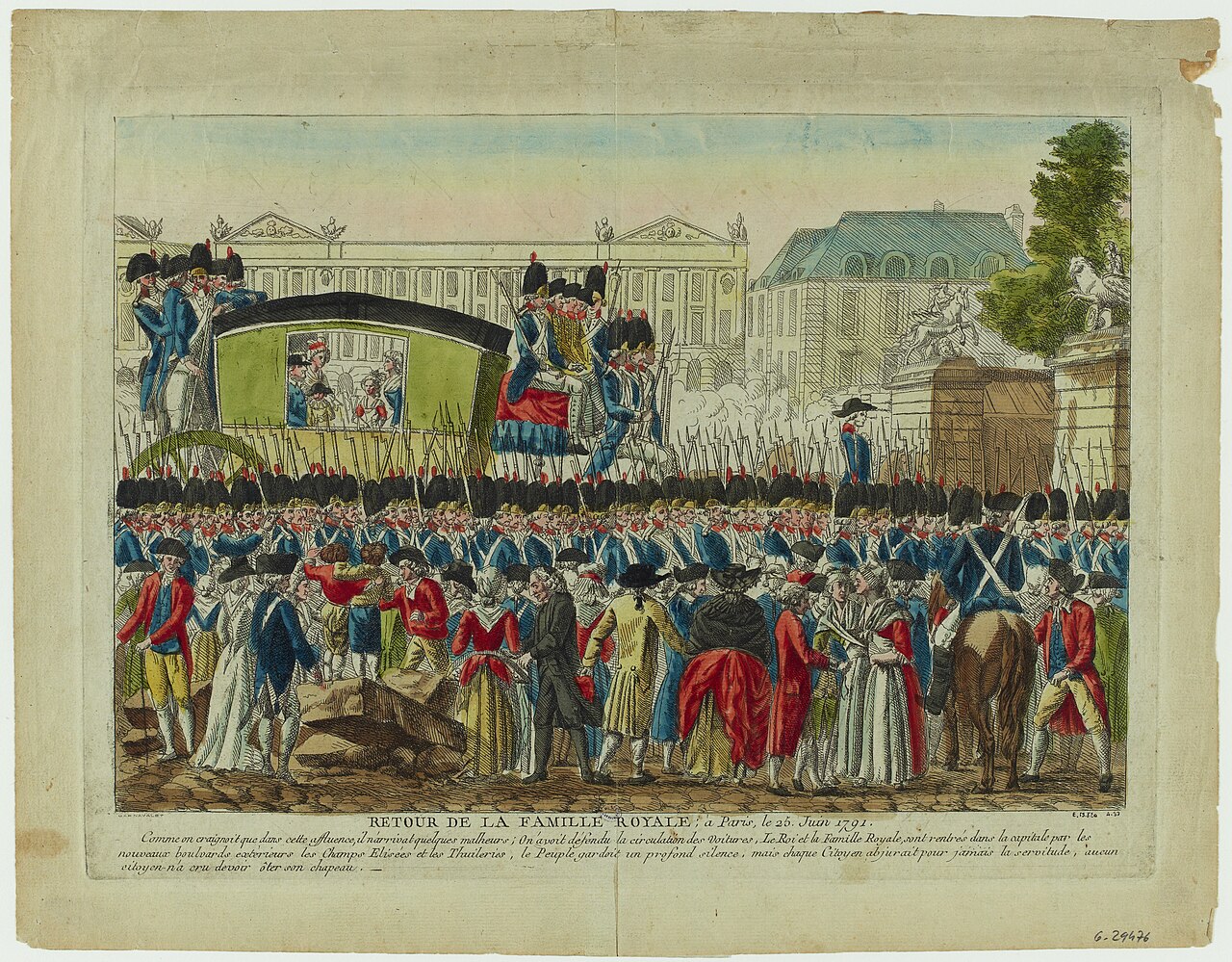
Louis XVI and his family are escorted back to Paris. Louis XVI and his family are arrested during an ill fated escape from France.
When the royal family returned from Varennes under escort, municipal authorities confronted volatile crowds. Bailly's administration supported arrangements intended to prevent fresh violence around the Tuileries.
Gilbert du Motier Lafayette figured in events surrounding guard strengthened at tuileries at Paris. The monarchy now functioned under close revolutionary supervision. The incident revealed how policing, local officials and transport delays could defeat the royal escape plan.
Military escorts helped conduct the royal family back to Paris after the unsuccessful flight to Varennes. The soldiers' presence underscored the transition from royal freedom of movement to guarded residence.
Madame Elisabeth returns to captivity in the Tuileries after the Varennes episode.
Marie Antoinette returns to the Tuileries under guard after the failed flight to Varennes.
Returns to the Tuileries under guard after the failed flight to Varennes.
Marie Antoinette returned to Paris with Louis XVI under heavy escort after the Varennes failure. The restrained and hostile public reception reflected the profound damage done to the monarchy's legitimacy.
Louis XVI and his family arrived back in Paris under escort after being stopped at Varennes. Their return did not restore confidence in the king's commitment to the constitutional settlement.
Desmoulins attacks the royal flight in revolutionary journalism and supports stronger popular action.
The king's attempted escape strengthened Brissot's doubts about royal trustworthiness. The crisis encouraged him and other journalists to reconsider the limits of constitutional monarchy.
Marie Antoinette endures the guarded journey back to Paris under hostile public scrutiny.
Petion became one of the deputies sent to accompany the royal family back from Varennes. The guarded return revealed the fragility of confidence between the king and the nation.
Barnave argued that the king's attempted escape should not automatically overthrow the planned constitutional monarchy. His position reflected the Assembly majority's fear of a wider political rupture.
Robespierre treated the flight to Varennes as a serious warning that the executive could undermine national sovereignty. The crisis intensified criticism of royal inviolability.
The failed royal escape encouraged demands for a republic among political clubs and petitioners. Bailly continued to favour constitutional authority rather than an immediate municipal break with monarchy.
Danton's circle insisted that the nation should reconsider Louis XVI's position after Varennes. The episode concerned republican petitions become flashpoint and affected the relationship between club activists and public authority.
Barnave defended royal inviolability and constitutional monarchy after the Flight to Varennes.
Following the Varennes crisis, republican campaigners demanded action against Louis XVI. Bailly resisted the claim that the city government should independently overturn the constitutional arrangements being prepared by the Assembly.
Adrien Duport joined the Feuillant split after the Varennes crisis.
National Guards under Lafayette confronted a crowd petitioning against the monarchy at the Champ de Mars. The resulting bloodshed exposed the deep political divisions produced by the Varennes crisis.
Gilbert du Motier Lafayette figured in events surrounding champ de mars demonstration suppressed at Champ de Mars. The resulting bloodshed exposed the deep political divisions produced by the Varennes crisis. The crisis intensified the divide between constitutional monarchists and activists who doubted that the king could be trusted.
Desmoulins promoted a more radical public response to the Varennes affair through journalism. The atmosphere surrounding the petition reflected an emerging republican challenge to hereditary monarchy.
Beauharnais was elected again as president of the National Assembly after his calm handling of the Varennes crisis.
Brissot participated in a climate of public agitation over how to hold Louis XVI accountable after Varennes. Disputes about petitions and sovereignty divided constitutional monarchists from radical reformers.
Petion's political standing benefited from public distrust of those who defended the king after Varennes. The massacre made the distinction between a parliamentary settlement and popular consent even more contentious.
Barnave ended his constituent service as the Assembly completed a written framework for the monarchy. The regime's durability depended on a degree of trust that the Varennes crisis had already undermined.
Uses the royal flight to intensify pressure against the monarchy.
Uses the crisis to question whether France can safely retain Louis XVI as king.
Denounces the attempted royal flight as evidence of court hostility to the Revolution.
Flees after the collapse of the royal escape plan.
Attacks the king's veto and supports stronger popular pressure after the Varennes crisis.
The Constitution of 1791 retained a monarchy that Desmoulins deeply distrusted after Varennes. His writing reflected growing impatience with a settlement dependent on Louis XVI.
Danton was associated with the Cordeliers' movement to seek a decision on the monarchy after the Varennes crisis.
Hébert criticized efforts to restore confidence in the monarchy after the royal flight. His newspaper presented distrust of the court as a necessary defense of revolutionary gains.
After the royal family's failed flight, Danton joined those demanding a clear political reckoning over the king's reliability.
Desmoulins supported more forceful popular demands after Varennes. The petition campaign brought republican-minded activists into conflict with leaders seeking to preserve the monarchy.
After Louis XVI tried to escape France, Desmoulins attacked the court's credibility. He presented Varennes as evidence that the monarchy could not be trusted to defend the constitutional settlement.
The Assembly imposed tighter restrictions on the royal household after Varennes. Marie Antoinette's political correspondence and the movement of trusted attendants became more sensitive under increased observation.
Louis XVI took place on the anniversary of the Tennis Court Oath and the Flight to Varennes. Listens to demands for new laws on priests and federes and to recall ministers. Dons the cap of liberty.