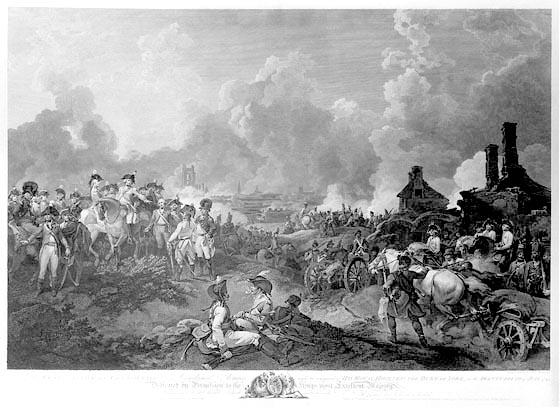
The contested northern French fortress in 1793. Explore the related historical entries from the same archive as the main French Revolution records.
10 March 1793 · Paris
Revolutionary Tribunal established: Security legislation defended
Maximilien Robespierre
Robespierre accepted emergency measures as part of the republic's struggle against counter-revolution. Their implementation raised profound questions about legal safeguards and political dissent.
April 1793 · Valenciennes
Coalition Army Threatens Valenciennes Defences
Josias von Sachsen-Coburg-Saalfeld
After regaining territory in the Austrian Netherlands, Coburg's army advanced against northern French fortresses. Valenciennes became a major target because it guarded strategic routes into France.
April 1793 · Northern France
Dampierre Organizes French Counterattacks near Valenciennes
Auguste Marie Henri Picot de Dampierre
Dampierre attempted to disrupt Coalition positions before the town could be fully invested. His troops faced an opponent strengthened by experienced cavalry and artillery.
8 May 1793 · Raismes
Battle near Raismes Blocks French Relief Effort
Auguste Marie Henri Picot de Dampierre
Dampierre's offensive against Coalition lines met determined resistance in the Raismes area. The failure left French positions near Valenciennes increasingly vulnerable.
8 May 1793 · Raismes
Dampierre Mortally Wounded during Fighting
Auguste Marie Henri Picot de Dampierre
The French commander received a fatal wound during efforts to strike Coalition forces near Valenciennes. His death deprived the Army of the North of its leader at a critical time.
23 May 1793 · Famars
Coalition Captures Famars Defensive Camp
Josias von Sachsen-Coburg-Saalfeld
Coburg's army defeated French forces in the fighting around Famars. The loss opened the way for the systematic investment of Valenciennes.
May 1793 · Valenciennes
Duke of York Assigned Siege Command
Frederick Augustus of York
The Duke of York led the force tasked with reducing Valenciennes while other Allied troops protected the operation. His command included British units working with Austrian specialists.
May 1793 · Valenciennes
Ferrand Takes Responsibility for Fortress Defence
Jean Henri Becays Ferrand
Ferrand commanded the garrison responsible for resisting a major Coalition siege. His troops prepared to hold fortified positions despite uncertainty about relief from the field army.
May 1793 · Valenciennes
Ferraris Directs Technical Siege Preparations
Joseph de Ferraris
Austrian general Ferraris supervised the engineering approach to the fortress. He preferred systematic trenches and batteries to a risky immediate assault.
May 1793 · Valenciennes
French Survivors Reinforce Valenciennes Garrison
Jean Henri Becays Ferrand
Troops falling back after the defeat at Famars entered the fortified town. Their arrival increased the number of defenders but also complicated provisions and accommodation.
13 June 1793 · Valenciennes
Siege Engineers Begin Formal Trench System
Joseph de Ferraris
Coalition specialists opened approaches toward the fortifications under covering fire. The deliberate method aimed to bring heavy guns close enough to breach or neutralize defensive works.
June 1793 · Valenciennes
Allied Guns Target Valenciennes Outer Works
Joseph de Ferraris
Heavy artillery sought to weaken the complex defenses before infantry attacks. The bombardment supported a gradual advance rather than a single improvised rush.
June 1793 · Valenciennes
Allied Siege Force Isolates Fortress Approaches
Frederick Augustus of York
The Duke of York's troops blocked roads and established camps around Valenciennes. The investment sought to prevent reinforcements reaching the French garrison.
June 1793 · Valenciennes
British Troops Protect Allied Siege Batteries
Frederick Augustus of York
British formations assisted the Austrian directed siege by guarding positions and supporting engineering work. Their participation reflected the multinational nature of the Coalition expedition.
June 1793 · Northern France
Coalition Covering Army Guards Siege Approaches
Josias von Sachsen-Coburg-Saalfeld
Coburg stationed field troops beyond the immediate siege lines. This screen was intended to repel any French army attempting to rescue Valenciennes.
June 1793 · Valenciennes
Ferrand Organizes Defensive Artillery Positions
Jean Henri Becays Ferrand
The garrison manned batteries intended to disrupt advancing siege works. French gun crews had to conserve ammunition while contesting the enemy's gradual approach.
June 1793 · Valenciennes
Valenciennes Civilian Population Endures Bombardment
Jean Henri Becays Ferrand
The siege placed residents at risk from shells and damage to buildings. Ferrand's defenders operated amid growing pressures on civilian supplies and urban infrastructure.
June 1793 · Valenciennes
York Demands Progress despite Siege Delays
Frederick Augustus of York
British commanders became frustrated with the slow engineering schedule. Differences between their preferences and Austrian procedures complicated the Allied command relationship.
25 July 1793 · Valenciennes
Mines Explode beneath Defensive Works
Joseph de Ferraris
Allied engineers detonated prepared mines beneath the outer fortifications. The blasts helped create conditions for an infantry assault on the damaged positions.
26 July 1793 · Valenciennes
Coalition Infantry Storms Valenciennes Hornworks
Frederick Augustus of York
British and Austrian columns attacked advanced works after the mining operation. Their success made continued French resistance increasingly difficult.
26 July 1793 · Valenciennes
Duke of York Calls for Surrender
Frederick Augustus of York
Following the breakthrough the Allied commander sent a summons to Ferrand. The demand made clear that Valenciennes faced the prospect of a renewed attack if negotiations failed.
26 July 1793 · Valenciennes
French Garrison Loses Key Outer Positions
Jean Henri Becays Ferrand
The defenders could not retain every work attacked by Coalition troops. Loss of the hornworks exposed the main position to closer artillery and assault.
27 July 1793 · Valenciennes
Ferrand Requests Pause for Negotiations
Jean Henri Becays Ferrand
The French commander sought time to discuss surrender terms after the fall of key defenses. Negotiations reflected the deteriorating military position of his garrison.
28 July 1793 · Valenciennes
Valenciennes Capitulates to Coalition Forces
Jean Henri Becays Ferrand
Ferrand surrendered the fortress after the siege had rendered continued resistance increasingly dangerous. The defeat deprived France of an important fortified town on the northern frontier.
28 July 1793 · Valenciennes
Valenciennes Surrenders After Bombardment
Jean Henri Becays Ferrand
The garrison under Ferrand surrendered Valenciennes after a sustained allied siege. Loss of the fortress opened another threat to the French interior.
July 1793 · Valenciennes
Allied Artillery Intensifies Pressure on Fortifications
Frederick Augustus of York
The besiegers brought heavier fire against Valenciennes as their batteries moved closer. Sustained bombardment prepared the ground for attacks on advanced defensive structures.
July 1793 · Valenciennes
Allied Command Concentrates against Eastern Hornworks
Frederick Augustus of York
The besiegers focused on prominent outer works east of the town. Capturing these positions would bring troops and guns closer to the main fortress line.
July 1793 · Valenciennes
Allied Troops Occupy Valenciennes Fortress
Frederick Augustus of York
Coalition soldiers entered the city following the negotiated capitulation. The occupation strengthened the invaders' immediate strategic position inside northern France.
July 1793 · Northern France
Defeat Exposes Fragility of Republican Frontier
Jean Henri Becays Ferrand
Valenciennes had been expected to help protect France from invasion. Its surrender showed that fortified towns could not endure indefinitely without effective field armies.
July 1793 · Valenciennes
French Defenders Await Expected Relief Attempt
Jean Henri Becays Ferrand
Ferrand's garrison remained isolated while military commanders elsewhere debated possible countermeasures. The lack of an effective field operation weakened prospects for a prolonged defense.
July 1793 · Valenciennes
Garrison Resists Continued Coalition Bombardment
Jean Henri Becays Ferrand
French troops maintained their positions while besiegers strengthened batteries and trench lines. The defense consumed resources as the possibility of timely relief diminished.
July 1793 · Northern France
Northern Army Cannot Relieve Valenciennes
Adam Philippe de Custine
The French field forces failed to mount an effective rescue of the besieged town. Custine's difficulties contributed to accusations that he had neglected the national defense.
July 1793 · Valenciennes
Siege Mines Prepared beneath Outer Positions
Joseph de Ferraris
Coalition engineers dug toward the defensive works and prepared explosive charges. Mining was intended to open breaches that infantry could exploit.
July 1793 · Northern France
Valenciennes Capture Strengthens Coalition Advance
Josias von Sachsen-Coburg-Saalfeld
The fall of the fortress added to a series of Allied successes during the summer of 1793. Coburg's army could now consider further operations without leaving this stronghold behind its lines.
23 August 1793 · Paris
Reform of Armed Forces
Napoleon I
A levee en masse is raised aiming to enlist 16,000 men.
August 1793 · Le Quesnoy
Coalition Operations Extend toward Le Quesnoy
Josias von Sachsen-Coburg-Saalfeld
After Valenciennes fell, Allied forces continued pressure against other northern fortresses. The campaign compounded the Republic's strategic difficulties before the autumn French recovery.
October 1793 · Paris
French Victory Raises Carnot Reputation
Lazare Nicolas Marguerite Carnot
Carnot's participation in the relief campaign reinforced his standing as an organizer of military resistance. The success came during a year of acute danger for the Republic.
October 1793 · Northern France
Jourdan Later Seeks to Reverse Northern Losses
Jean-Baptiste Jourdan
Jourdan assumed command while the Republic remained threatened by Coalition positions gained earlier in the year. His subsequent Wattignies victory helped end the immediate danger to Maubeuge though Valenciennes stayed occupied.
October 1793 · Paris
Wattignies Becomes Symbol of Republican Recovery
Jean-Baptiste Jourdan
Jourdan's victory was celebrated as proof that France could defend itself during the emergency of 1793. It strengthened confidence in troops raised and reorganized by the revolutionary state.
October 1793 · Northern France
Wattignies Reverses Sequence of Fortress Losses
Jean-Baptiste Jourdan
Earlier Coalition successes at Valenciennes and other northern fortresses had placed the Republic under severe pressure. Jourdan's success demonstrated that the enemy advance could be checked in open battle.
1793 ·
Army of the North
Picot Dampierre
Picot Dampierre was appointed Commander of the Army of the North.
1793 · Valenciennes
Attempt to Relieve Valenciennes
Auguste Marie Henri Picot de Dampierre
Dampierre directed operations intended to loosen Coalition pressure on Valenciennes, but his troops faced formidable defensive positions.
1793 · Northern France
Custine Called to Northern Command
Adam Philippe Custine
Adam Philippe Custine took over the Army of the North amid anxiety over lost ground, weak organization and the threat to Valenciennes.
1793 · Northern France
Dampierre Assumes Command After Defection
Auguste Marie Henri Picot de Dampierre
Auguste de Dampierre tried to stabilize the Army of the North while Coalition troops threatened French positions and local fortresses.
1793 · Northern France
Dampierre Leads Attempts to Stabilize Front
Auguste Marie Henri Picot de Dampierre
Dampierre assumed command amid the retreat from Belgium and tried to reorganize the northern army. His operations sought to defend French frontier positions.
1793 · Raismes
Dampierre Mortally Wounded Near Raismes
Auguste Marie Henri Picot de Dampierre
Dampierre was fatally wounded during fighting near Raismes, depriving the northern army of its commander during a dangerous campaign.
1793 · Raismes
French Counterattack Near Raismes Costs Commander
Auguste Marie Henri Picot de Dampierre
Dampierre was mortally wounded during fighting near Raismes in May 1793. His loss weakened the French command during coalition pressure on Valenciennes.
1793 · Northern France
Lamarche Takes Temporary Northern Command
Francois Joseph Drouot de Lamarche
Francois Joseph Drouot de Lamarche assumed command following Dampierre's death and inherited a deteriorating strategic situation.
1793 · Paris
Reform of Armed Forces
Georges Jacques Danton
Raises the 1st ever compulsory national conscription. Carried out by the French Committee of Public Safety.
1793 · Paris
Reform of Armed Forces
Lazare Nicholas Marguerite Carnot
Raises the Levee En Masse conscripting the entire male population of France, August. Creates 14 armies from untrained recruits.
1793 · Northern France
Three-hundred-thousand-man levy
Lazare Nicolas Marguerite Carnot
Carnot helped implement the early 1793 recruitment campaign intended to raise troops for armies facing the Coalition.
1793 · Valenciennes
Valenciennes Garrison Resists Coalition Siege
Jean Henri Becays Ferrand
Ferrand commanded the French defenders of Valenciennes during a prolonged coalition siege. Continued resistance tied down enemy troops but could not prevent eventual capitulation.
June 1794 · Northern France
French Campaign Presses toward Occupied Valenciennes
Jean-Baptiste Jourdan
Republican advances during 1794 gradually undermined Coalition control of northern France. The wider success at Fleurus helped make continued occupation of isolated French fortresses difficult.
August 1794 · Valenciennes
Valenciennes Returns to French Control
Jean-Baptiste Jourdan
The shifting military situation compelled the Coalition to abandon Valenciennes in the summer of 1794. Its recovery marked the reversal of an important enemy gain from the previous year.
September 1794 · Rhineland
French Advances Threaten German Frontier Positions
Jean-Charles Pichegru
Operations along the Rhine challenged Coalition security beyond French territory. The shifting front raised questions about occupation and the political future of neighboring German lands.