Reign of Terror
Maximilien Francois Marie Robespierre
Robespierre promoted a Republic of Virtue while Jacobin rule intensified repression before his overthrow on 9 Thermidor.
The fall of Robespierre and the political aftermath. Explore the related historical entries from the same archive as the main French Revolution records.
Robespierre promoted a Republic of Virtue while Jacobin rule intensified repression before his overthrow on 9 Thermidor.
The Law of 22 Prairial allowed the public prosecutor to bring suspects to judgment under far fewer procedural safeguards. Executions increased sharply during the final weeks before Thermidor.
Saint-Just prepares to defend the Committee of Public Safety as opposition to Robespierre grows.
Saint-Just prepares to defend Robespierre and the authority of the Committee of Public Safety.
Robespierre addresses the National Convention and warns of unnamed conspirators within the government.
Robespierre refuses to name the deputies he accuses and increases fear among members of the Convention.
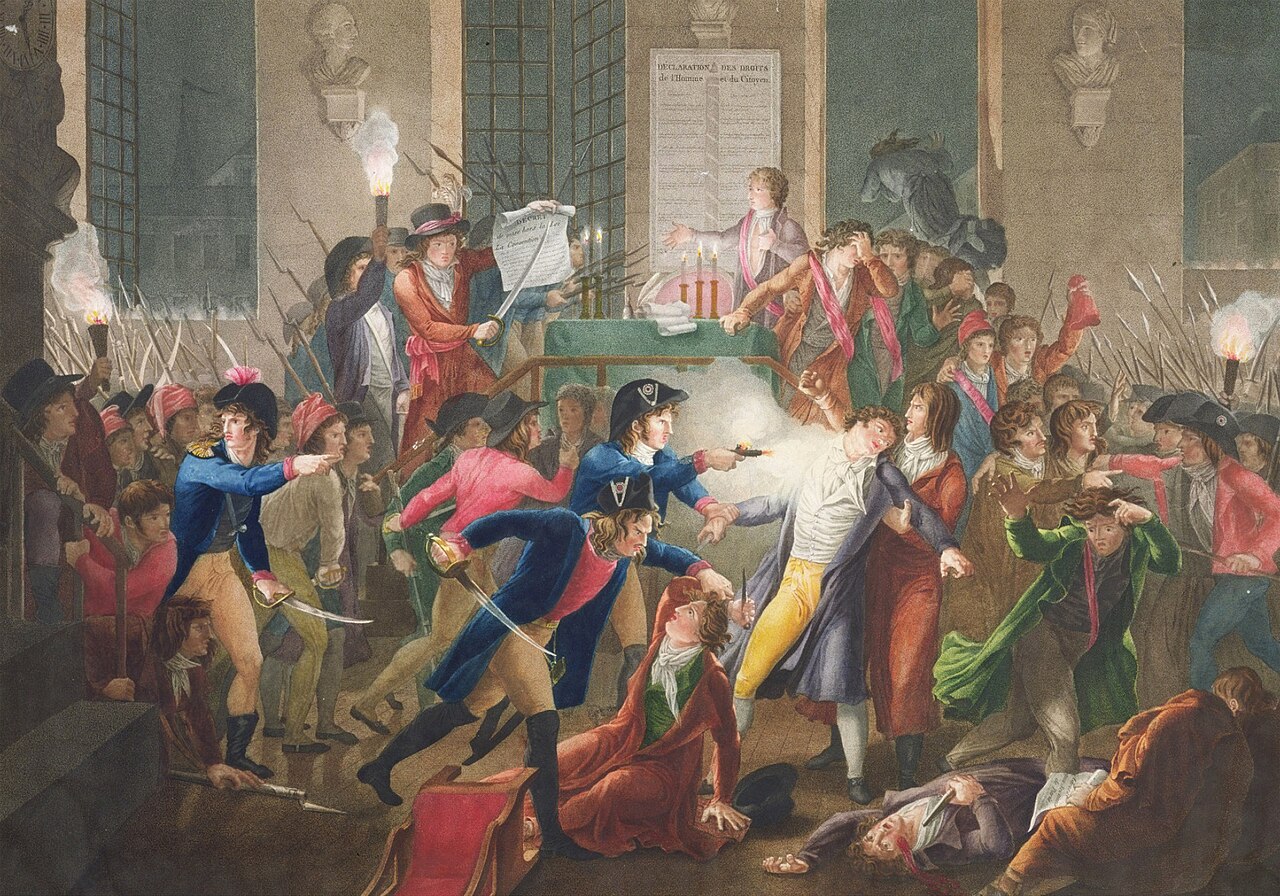
Robespierre was overthrown during the revolution of 9 Thermidor.
Couthon was named among Robespierre's associates to be arrested by the Convention. The decree struck at several central figures in the Terror simultaneously.
Georges Auguste Couthon figured in events surrounding couthon seized in thermidor at Paris. The decree struck at several central figures in the Terror simultaneously. Its importance lay in the transfer of effective authority away from the political networks that had dominated during the Terror.
The Jacobin Club is closed after the execution of Robespierre and other members on 9 Thermidor of the year II (27 July 1794).
Hanriot attempted to rally armed support for Robespierre when the Convention turned against him. The response of National Guard units was divided and insufficient to reverse the deputies' action.
When the Convention moved against Robespierre, Hanriot attempted to mobilize his guards in opposition. His order faced uncertain obedience from units with divided political loyalties.
During the Thermidorian struggle Hanriot sought to mobilize force against the Convention's arrests. His efforts failed to sustain an effective coalition of armed sections.
Saint-Just tried to deliver a report during the sitting of 9 Thermidor but opponents interrupted him. His inability to complete the address deprived Robespierre's allies of a planned defense.
Tallien helped lead the confrontation in the National Convention against Robespierre on 9 Thermidor. His intervention emboldened members who wanted to arrest the leading Robespierrists.
Robespierre is denounced in the Convention on 9 Thermidor and the Jacobin political system begins to collapse.
Augustin Robespierre demands to share the fate of his brother and is arrested.
Barere accepts the turn against Robespierre and supports emergency measures by the Convention.
Payan encourages the Commune to rally the sections in defence of Robespierre.
Hanriot attempts to mobilise armed support for Robespierre in Paris.
Couthon is arrested with Robespierre and other leading Robespierrists.
Billaud-Varenne denounces Robespierre and joins the deputies demanding his arrest.
Fleuriot-Lescot uses the Paris Commune to support Robespierre after the arrest order.
Tallien attacks Robespierre before the National Convention and helps start the revolt of 9 Thermidor.
Collot dHerbois presides during the stormy Convention session against Robespierre.
Amar aligns with opponents of Robespierre as the Convention turns against the Jacobin leadership.
Carnot stands with members of the government who reject Robespierres domination.
Saint-Just is interrupted before he can deliver his defence of Robespierre.
Legendre helps prevent Robespierre from rallying support in the Convention.
Freron supports the Convention attack on the Robespierrists.
Vadier supports the attack on the Robespierrist faction during the Convention crisis.
Barras is given command of Convention forces against the Paris Commune.
Le Bas remains loyal to Robespierre during the crisis and is arrested with the faction.
Dumas supports the Commune resistance and is later seized with the Robespierrists.
The arrest of Robespierre undermined the political network directing emergency judicial policy. Tribunal officials closely associated with his faction quickly became vulnerable.
Tallien helped unite Convention opponents against Robespierre on 9 Thermidor. The arrests destroyed the political leadership most closely associated with the Jacobins.
Augustin Robespierre joined supporters gathered at city hall during the Thermidorian confrontation. His fate became linked to the collapse of the Commune's attempted resistance.
Barras leads Convention forces against the Commune stronghold during the night of 9 to 10 Thermidor.
Saint-Just is executed with Robespierre and other allies after the Thermidorian revolt.
Robespierre is executed by guillotine on 10 Thermidor after being declared an outlaw.
Hanriot was executed following the defeat of the Thermidorian insurgency. His death ended the period when one radical commander closely linked the Paris Guard to Robespierre's supporters.
Forces acting for the Convention retook control from the Robespierrist Commune during the night of 9 to 10 Thermidor. Barras's command helped ensure that the rebels could not hold the Hôtel de Ville.
Payan was taken into custody after the Commune's call for armed resistance failed. The defeat destroyed the political network through which he had directed municipal mobilization.
Robespierre was guillotined on 10 Thermidor after the collapse of the municipal rising. His execution marked the decisive defeat of the political circle most identified with the Terror.
Tallien becomes one of the visible leaders of the victorious Thermidorian deputies.
Barras gains influence after commanding the troops that defeated the Commune.
Executions of surviving leaders of the Paris Commune continued after the fall of Robespierre. These punishments dismantled the municipal command structure that had attempted to defy the Convention.
During Thermidor Barras commanded troops supporting the Convention against insurgent municipal authorities. The victory undermined the radical political leadership of the capital's armed citizens.
Robespierre tries to found the Republic of Virtue, until the Jacobins last purge, 9 Thermidor, in July 1794, executed Robespierre himself.
The Reign of Terror reached its political peak under the emergency committees before Robespierre’s fall on 9 Thermidor.
Robespierre's overthrow exposed the political dangers of a court associated with emergency government. Deputies began disputing whether its procedures could be reconciled with republican legality.
In the immediate aftermath of Thermidor the Convention began dismantling the extraordinary procedures associated with the Terror. Tallien belonged to the ascendant faction pressing against renewed concentration of punitive power.
The defeat and execution of Hanriot eliminated a leading link between the Paris National Guard and Robespierre's supporters. New authorities sought to limit the force's ability to challenge national representatives.
After Thermidor the Convention investigated figures associated with exceptional prosecutions. Fouquier Tinville faced mounting scrutiny of the institution in which he had exercised prosecutorial authority.
The National Convention orders the Jacobin Club in Paris closed during the Thermidorian reaction.
The Jacobin Club is closed as the Thermidorian Reaction weakens radical political organisation.
The Convention closed the Jacobin Club amid the Thermidorian reaction. The decision ended the leading Parisian society's central role in revolutionary political mobilization.
The Law of the Maximum is repealed during the Thermidorian retreat from economic controls.
Carrier was executed after proceedings focused on the brutal repression associated with Nantes. His fate illustrated how the Thermidorian regime punished selected officials of the earlier Terror.
Jean-Baptiste Carrier figured in events surrounding carrier condemned at Paris. His fate illustrated how the Thermidorian regime punished selected officials of the earlier Terror. This episode contributed to the replacement of centralized Jacobin emergency rule with a less unified, more conservative Convention.
Freron encouraged militants who confronted remaining Jacobin supporters in Paris after Thermidor. Organized street pressure weakened the club's ability to defend itself.
Barras joined the group of deputies that opposed Robespierre and his close supporters. Fear of purges helped unite otherwise divided Convention members during the Thermidor crisis.
Tallien attacked Robespierre in the Convention as deputies joined to overthrow the political leadership associated with the Terror.
Barras entered the Committee of General Security after Thermidor. Membership placed him within an institution still responsible for political policing during the transition away from the Terror.
Carnot continued military work as revolutionary government changed personnel and procedures after the fall of Robespierre.
The Convention ordered Saint-Just arrested alongside Robespierre and leading allies during the crisis of 9 Thermidor.
After the defeat of the Robespierrists the Convention reduced the Paris Commune's capacity to challenge national government. Municipal autonomy was curtailed under the Thermidorian settlement.
Payan was executed following the defeat of the Thermidorian uprising. His death removed one of the officials most closely identified with the Commune's last defense of Robespierre.
The former mayor was guillotined in the immediate aftermath of 9 Thermidor. His fate signaled the destruction of the Commune's leadership as an independent political force.
The French victory at Fleurus preceded the overthrow of Robespierre by about one month. The reduced threat of invasion became part of the changing context of revolutionary politics.
The downfall of Robespierre prompted scrutiny of the public prosecutor's role in the Terror. Fouquier Tinville was subsequently arrested and faced prosecution for judicial abuses.
The Convention repealed wartime price controls late in 1794, exposing consumers to rising costs and intensifying criticism of Thermidorian economic policy.
Hanriot attempted to deploy National Guard units against the Convention's arrest orders. His efforts failed as competing authorities claimed command of armed men.
Robespierre tries to found the Republic of Virtue, until the Jacobins last purge, 9 Thermidor, in July 1794, executed Robespierre himself.
Thermidor is an alliance between those who felt Robespierre had gone too far and those who felt he had not gone far enough they were unable to maintain their control of the Convention.
The period after the Prairial law saw a substantial escalation of Revolutionary Tribunal executions, ending only after the Thermidorian crisis.
On 9 Thermidor, Fleuriot-Lescot backed municipal resistance to the arrest of Robespierre and his allies. The Hôtel de Ville became a gathering place for the embattled group.
Saint-Just was treated as an outlaw following the Thermidorian revolt, leading to execution without a conventional criminal trial.
Payan sought to rally section activists in support of the threatened Robespierrists. Responses were uneven, leaving the Commune without a reliable mass force.
Barras benefited from his role in the overthrow of Robespierre. The victory strengthened his claim to leadership as the Convention reduced the concentration of emergency power.
The wider atmosphere of suspicion created by accelerated trials helped strain relations among revolutionary leaders before Robespierres fall.
Saint-Just prepared a defense of the revolutionary leadership as opposition to Robespierre gained strength within the Convention.
Collot d Herbois chaired a turbulent session as the Convention ordered the arrest of Robespierre and close political associates.
Fouche survived the Thermidorian reversal and maneuvered among deputies who sought to curtail the authority of surviving Jacobin networks.
Gregoire argued that political institutions should protect freedom of worship rather than impose revolutionary tests of religious belief.
The collapse of municipal resistance on the night of 9 to 10 Thermidor gave the Convention control of Paris. Barras emerged with enhanced standing among the victorious deputies.
The fall of Robespierre placed officers associated with his political circle under suspicion. Bonaparte was briefly detained but emerged without a lasting conviction and resumed seeking a useful command.
Robespierre’s overthrow on 9 Thermidor united opponents of different factions and began a rapid decline in Jacobin power.
On 9 Thermidor the Convention entrusted Barras with command of armed forces defending it against the insurgent Commune. His position gave the anti-Robespierrist deputies a military organizer.
Robespierre fell in July, months after the death of his former friend Desmoulins. The reversal intensified retrospective debate about factional prosecutions under the Terror.
Robespierres fall changed the balance inside the Convention and reduced the danger faced by politicians previously associated with the moderate opposition.
The fall of Robespierre reopened debates over legal safeguards and institutional restraint that were central to Sieyes constitutional concerns.
Tallien and other victors curtailed the structures that had enabled the Commune to pressure national representatives. The reaction aimed to prevent another insurrectionary municipal government.
Carnot remained in government after the overthrow of Robespierre, although accounts differ about the extent of his direct involvement in the coup.
Fouche survives the fall of Robespierre and aligns with the Thermidorian order.
As the Convention reviewed the actions of officials associated with the Terror, Barras participated in a political environment demanding accountability. The reaction reshaped both policing and the careers of revolutionary deputies.
Saint-Just's custody was caught up in the confused struggle between Convention authorities and supporters of the arrested leaders.
Barras publicly attacked returning emigres as Thermidorian politics moved against royalist influence before the establishment of the Directory.
Sieyes entered the Committee of Public Safety during the final phase of the Convention and participated in post-Thermidor government.
The post Thermidor government relied on troops and armed supporters when popular crowds challenged the Convention. Control of the capital's armed units remained essential to the survival of the ruling deputies.
Fouquier Tinville was condemned after a lengthy trial examining his conduct during the Terror. His execution symbolized the Thermidorian backlash against revolutionary judicial repression.
Tallien returned to the Committee of Public Safety as Thermidorian leaders confronted renewed unrest in Paris.
The Council of Ancients chose Barras for the five-member Executive Directory from candidates proposed under the new constitution. His appointment placed an influential Thermidorian politician in the executive government.
Boissy d Anglas faced demands for food during the spring uprisings, illustrating how hunger destabilized the Thermidorian Republic.
Sieyes joined the Committee of Public Safety during the Thermidorian period, when the government was moving away from the dictatorship of emergency committees.
The Thermidorian authorities and anti Jacobin activists continued to target radical clubs and militants. The collapse of organized Jacobin influence transformed the political life of the capital.
Dobsen presided over the Revolutionary Tribunal after the Robespierrist collapse. The court continued under a changing political regime that increasingly investigated former officials.
After his Italian command prospects deteriorated, Bonaparte resisted reassignment to an infantry post against western insurgents. His uncertain status reflected the instability of military appointments after Thermidor.
La Revelliere Lepeaux resumed public prominence as Thermidorian deputies prepared a new constitution that separated legislative and executive authority.
The fall of the Terror weakened the forces most threatening to Talleyrand's position. He began to anticipate restoration of his standing in French public life.
Food scarcity and collapsing purchasing power increased anger among Parisian workers as the Convention withdrew from strict economic controls.
Tallien supported repression of renewed sans-culotte pressure in 1795 as the Convention moved away from the political methods of Year II.