What was the Munich Agreement?
An agreement reached on 29–30 September 1938 by Germany, Britain, France and Italy that provided for German occupation of the Sudeten territories of Czechoslovakia.
The Munich Agreement of September 1938 transferred the Sudetenland from Czechoslovakia to Nazi Germany. Explore the causes of the Sudeten crisis, Chamberlain’s policy of appeasement, the four-power conference, the agreement’s terms and its consequences.

The Munich Agreement was the 29–30 September 1938 settlement in which Germany, Britain, France and Italy accepted the transfer of the Sudetenland from Czechoslovakia to Nazi Germany.
The agreement ended the immediate September crisis without a European war, but it did so at Czechoslovakia’s expense. Adolf Hitler had demanded the German-speaking border districts of the Sudetenland; Neville Chamberlain and the French government pursued negotiation and territorial concessions in the hope of preventing a wider conflict. Czechoslovakia was not an equal participant in the conference that decided the fate of its territory.
The consequences were strategic as well as territorial. Czechoslovakia lost important border districts and defensive positions. German occupation of the designated Sudeten areas began on 1 October and was scheduled to be completed by 10 October. Poland then occupied Teschen, and the First Vienna Award of 2 November transferred further territory to Hungary.
Munich became the defining example of the policy later called appeasement. Chamberlain returned to Britain claiming that the settlement offered a basis for peace, while critics including Winston Churchill argued that it had strengthened Germany and weakened the European balance of power. Germany’s occupation of the Czech lands in March 1939 demonstrated that Hitler’s ambitions had not ended with the Sudetenland.
The Munich Agreement was the climax of the September 1938 Sudeten crisis. Britain and France sought to avoid an immediate European war; Hitler demanded the transfer of German-majority border districts; Czechoslovakia faced the loss of territory, fortifications and strategic depth.
An agreement reached on 29–30 September 1938 by Germany, Britain, France and Italy that provided for German occupation of the Sudeten territories of Czechoslovakia.
Adolf Hitler, Neville Chamberlain, Édouard Daladier and Benito Mussolini were the four leaders at Munich. Czechoslovakia was not an equal participant in the negotiations that determined the transfer of its territory.
The borderlands included a large German-speaking population, but they were also strategically important. The source chronology repeatedly records the loss of Czechoslovakia’s fortified and defensible frontier.
Chamberlain and the French government pursued negotiation and territorial concessions in an effort to avert war. The Munich settlement became the best-known example of the pre-war policy later labelled appeasement.
German forces entered the Sudetenland from 1 October, with occupation scheduled to be completed by 10 October. Edvard Beneš resigned on 5 October as the Czechoslovak political crisis deepened.
Munich temporarily avoided war in September 1938 but weakened Czechoslovakia. Germany occupied the Czech lands in March 1939, demonstrating that Hitler’s territorial ambitions had not ended with the Sudetenland.
Choose a country, event, person, place or phase, or enter a search term, to display records. Country, event and people lists are alphabetically grouped. The explorer contains 438 records and preserves conflicting source entries so the chronology remains inspectable.
Editorial note: the supplied dataset contains duplicates, alternate spellings, and some internally inconsistent dates or descriptions. The curated sections above use the clearest mutually consistent records; this explorer leaves the source rows unchanged apart from formatting. The chronology has been tightened to 438 records after removing 73 exact or near-duplicate entries while preserving distinct people, dates, places and events.
The diplomatic imbalance is central to the story: Britain, France, Germany and Italy negotiated over Czechoslovak territory while Prague confronted the consequences.
Demanded rapid German occupation and signed the agreement authorising the transfer of the Sudetenland.
View Hitler records →Pursued direct diplomacy with Hitler, signed at Munich, then returned to Britain arguing that war had been avoided.
View Chamberlain records →Represented France and accepted the transfer after emergency consultations during the crisis.
View Daladier records →Presented proposals closely reflecting German demands and publicly acted as mediator.
View Mussolini records →Faced Anglo-French pressure, mobilised during the Godesberg crisis, and ultimately accepted the imposed settlement rather than fight without expected British or French support. Beneš resigned on 5 October.
The September crisis accelerated through bilateral meetings, Anglo-French pressure, ultimata, mobilisation and a last-minute four-power conference.
Chamberlain meets Hitler and hears the demand that German-majority districts of Czechoslovakia be transferred to Germany.
British and French ministers develop proposals intended to avert war by transferring German-majority districts from Czechoslovakia.
Beneš receives the territorial plan and accepts only after Britain and France make clear that Czechoslovakia cannot expect their military support.
Milan Hodža resigns amid political anger; Jan Syrový forms a new government while Chamberlain returns to Germany for the Godesberg meeting.
Hitler rejects the earlier timetable, demands rapid evacuation and direct German occupation, and supplies a territorial map. Czechoslovakia orders general mobilisation.
Chamberlain returns to London with Hitler’s memorandum as British and French leaders consider the enlarged demands and the growing risk of war.
The Syrový government rejects the abandonment of fortified territory and prepares to resist if Germany attempts to enforce the Godesberg demands by force.
Hitler repeats his territorial demands while German military preparations continue. Chamberlain tells the British public that negotiations are still being pursued.
Hitler postpones military action and invites Chamberlain, Daladier and Mussolini to a four-power conference in Munich.
Germany, Britain, France and Italy negotiate the Sudeten settlement without Czechoslovakia participating in the conference negotiations.
The four powers settle the evacuation timetable and sign the Munich Agreement in the early hours. Prague is confronted with the imposed terms.
German forces enter the Sudetenland and complete occupation of the assigned zones under the Munich timetable.
The Czechoslovak president leaves office after the territorial losses and political collapse surrounding the settlement.
Germany occupies the Czech lands, violating the pledge that the Sudetenland would be Hitler’s final territorial demand.
The map sequence shows how the September 1938 settlement became a series of territorial losses: first the Sudeten cession and neighbouring claims in autumn 1938, then the destruction of the remaining Czechoslovak state in March 1939.
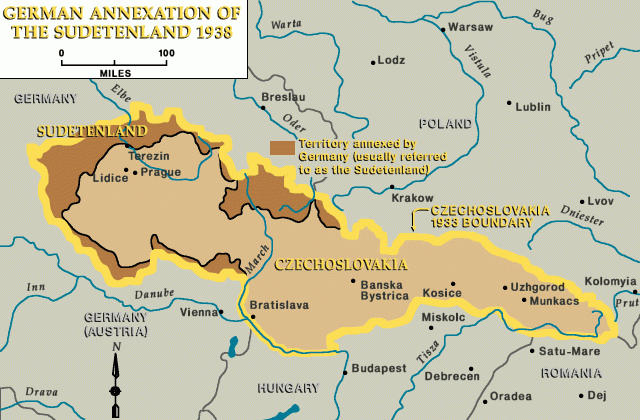
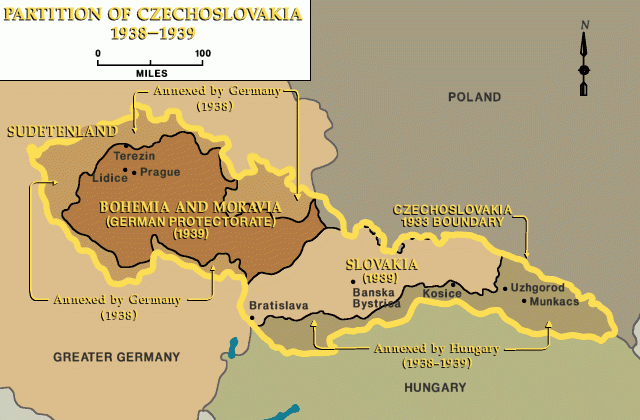
From the Munich settlement to the disappearance of Czechoslovakia as a sovereign state six months later.
Germany, Britain, France and Italy agree that Czechoslovakia must surrender the Sudetenland. The agreement provides for progressive evacuation and German occupation beginning on 1 October and finishing by 10 October.
The Czechoslovak government decides to accept the Munich terms rather than resist without expected British or French military support, clearing the way for the territorial evacuation to begin.
German troops enter the first occupation zones along Czechoslovakia’s border. The transfer starts to remove fortified positions, communications links and industrial districts from the remaining state.
Following a Polish ultimatum, the Czechoslovak government agrees to cede the disputed Teschen, or Zaolzie, district of Czech Silesia to Poland, widening the territorial losses beyond those imposed at Munich.
International Commission negotiations settle additional occupation areas, including a fifth German zone. Contemporary diplomatic reporting noted that the resulting border stripped Czechoslovakia of most of its strategic defences and disrupted major railway connections.
German troops complete the physical occupation of the territories assigned under the Munich timetable. For practical purposes, the transfer of the Sudeten areas has now taken place even though technical boundary work continues.
Boundary maps produced after the occupation show a frontier that is substantially final, with remaining disputes treated mainly as technical questions of delimitation rather than major political claims.
Germany and Italy arbitrate a further partition. Hungary receives large areas of southern Slovakia and a small part of southern Subcarpathian Rus, taking the post-Munich territorial settlement farther east.
After the territorial losses, the reduced state grants substantial autonomy to Slovakia and Subcarpathian Rus and adopts the name Czecho-Slovakia, reflecting how profoundly its political and geographic structure has changed.
Under intense German pressure, Slovakia leaves the remaining Czecho-Slovak state and becomes a separate republic closely aligned with Nazi Germany, removing another large part of the federation from Prague’s control.
German forces enter the Czech lands in direct violation of the Munich settlement. Bohemia and Moravia are placed under German control as the Protectorate of Bohemia and Moravia.
As the Czecho-Slovak state collapses, Hungary occupies and annexes Subcarpathian Rus. Together with Slovak independence and the German occupation of the Czech lands, this removes Czechoslovakia from the map.
Relief, controversy and the hardening of British policy, September 1938–May 1939.

On 30 September 1938 Chamberlain returned from Munich displaying the separate Anglo-German declaration he had signed with Hitler. At Downing Street he said he believed the settlement meant “peace for our time”. The immediate British response contained a powerful element of genuine relief: Europe had appeared close to war, and Duff Cooper later recalled large crowds outside Downing Street cheering, laughing and singing.
That distinction mattered. Chamberlain’s case was not simply that the European danger had disappeared; it was that personal diplomacy and negotiated revision had bought a chance to construct a wider settlement while Britain continued strengthening its defences.
The avoidance of immediate war produced public celebration and gave Chamberlain a major short-term political triumph. Duff Cooper, however, resigned from the Cabinet. In explaining his resignation he accepted the relief but rejected the mood of self-congratulation surrounding the settlement.
Attlee argued that Britain had gained an armistice rather than a secure peace and described the settlement in terms of humiliation and coercion. Churchill went further on 5 October, calling the outcome a “total and unmitigated defeat” and warning that Germany had gained strategically as well as territorially.
Germany’s occupation of the Czech lands showed that Hitler’s expansion had not ended with the Sudeten question. In his Birmingham speech on 17 March, Chamberlain said the occupation had produced a profound shock and treated the destruction of Czechoslovakia as evidence that the assumptions behind Munich could no longer be relied upon.
Britain still publicly favoured peaceful negotiation, but it now attached explicit commitments to resistance. On 31 March Chamberlain guaranteed British support if Polish independence were clearly threatened and Poland resisted. In April the government announced compulsory military training, followed by the Military Training Act in May.
The change after Prague was therefore substantial but not absolute. Britain did not renounce negotiation or immediately adopt a policy of preventive war. Instead, the government moved away from relying primarily on negotiated concessions and declarations of intent. Diplomacy was increasingly backed by security guarantees, faster military preparation and a willingness to make commitments in eastern Europe.
The Polish guarantee was especially significant. Chamberlain told the Commons that Britain remained committed to settling disputes by “free negotiation”, yet also stated that Britain would lend Poland all the support in its power if Polish independence were clearly threatened and Poland chose to resist. The introduction of compulsory military training a month later made the harder policy materially more credible.
Further reading: Chamberlain, Commons, 3 October 1938 · Churchill, Commons, 5 October 1938 · Chamberlain, Birmingham, 17 March 1939 · Polish guarantee, 31 March 1939 · Compulsory military training, April 1939.
The page combines a searchable historical dataset with a curated narrative checked against authoritative primary and institutional sources.
The chronology contains 438 records covering the diplomatic crisis, the Munich conference, occupation of the Sudetenland, subsequent territorial changes and the March 1939 destruction of the remaining Czechoslovak state. The explorer intentionally preserves conflicting or imperfect source entries where they remain useful for inspection; the explanatory sections use the clearest mutually consistent evidence.
The narrative has been cross-checked against published treaty text, parliamentary debate and institutional historical references. Links below are provided so readers can compare the curated account with the underlying documentary record.
Last reviewed and updated: 4 October 2026.