1645 13th June
Battle of Naseby
Stands on high ground on East Farndon over Great Oxendon, 2 miles south of Harborough
English Civil War · permanent subject timeline
The decisive New Model Army victory of June 1645. This page combines historical context with 26 matching records drawn directly from the World History Database English Civil War archive.
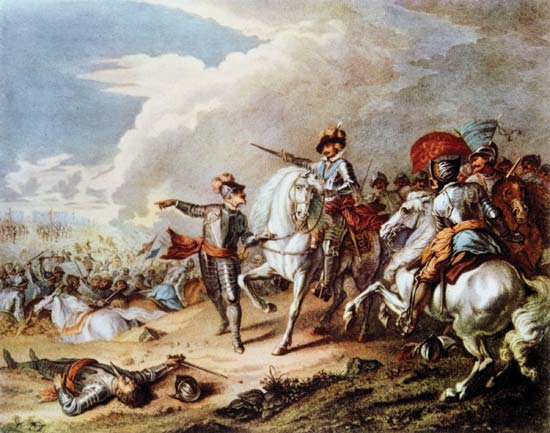
Historical context
The New Model Army under Thomas Fairfax and Oliver Cromwell defeated Charles I's principal field army at Naseby on 14 June 1645. Royalist infantry was overwhelmed after hard fighting while much of the king's military correspondence was captured.
Naseby was the decisive field battle of the First Civil War. The Royalists never again assembled a comparable army in England, and Parliament gained both military and political momentum.
World History Database records
The records below are selected from the 1,090-record English Civil War archive and rendered as static HTML in chronological order.
Battle of Naseby
Stands on high ground on East Farndon over Great Oxendon, 2 miles south of Harborough
Battle of Naseby
Commands a brigade of the Royalist Army
Battle of Naseby
Commands the infantry of the Royalist Army
Battle of Naseby
Commands a brigade of the Royalist Army
Battle of Naseby
The 1st Civil War lingers for another year until capitulation at Oxford 1 year later. Decisive victory for Parliamentary forces
Battle of Naseby
Commands Parliamentarian cavalry on the right and helps Fairfax defeat the king's main field army.
Battle of Naseby
Parliamentary victory, Charles has 7,500 men & Parliamentary forces number 13,500. Contributes to Charles downfall & the ascendancy of Cromwell & the independents
Battle of Naseby
With Cromwell's help defeats Charles force of 7,500. Leaves Guilsborough in the early hours & by sunrise the Army is ready on Naseby Bridge. A decisive victory over the royalists
Battle of Naseby
Fairfax commands the New Model Army in the decisive defeat of Charles I at Naseby.
Battle of Naseby
Fairfax directs the New Model Army at Naseby and wins the decisive victory over Charles I's main field army.
Battle of Naseby
Commands a Royalist Army, Charles I is defeated
Battle of Naseby
Commands a Royalist Army, Charles I is defeated
Battle of Naseby
Commands a Royalist Army, Charles I is defeated
Battle of Naseby
Ireton leads Parliamentarian cavalry on the left and is captured during the early fighting at Naseby.
Battle of Naseby
Fights at the Battle of Naseby for Parliament against Charles I
Battle of Naseby
Commands the right wing of the Royalist cavalry
Battle of Naseby
Commands a brigade of the Royalist Army
Battle of Naseby
Commands the Dragoons of the Parliamentary Army during a victory against the Royalists
Battle of Naseby
Commands a Parliamentary regiment in a victory over the Royalists
Battle of Naseby
Rupert's cavalry drives back part of the Parliamentarian line but cannot prevent Royalist defeat.
Battle of Naseby
Commands the infantry centre of the Parliamentary Army during their victory
Battle of Naseby
Commands the King's Horseguards of the Royalist Army
Battle of Naseby
Commands the Lifeguard for Parliament against the Royalists
Battle of Naseby
Commands a Regiment for Parliament against the Royalists
Battle of Naseby
Commands levies for the Royalists against Parliament
Battle of Naseby
Commands a regiment for Parliament against the Royalists
Editorial provenance
Compiled and edited by World History Database.
Historical context is editorial material; the chronology is generated from World History Database English Civil War records.
Last reviewed: September 2026.
English Heritage · National Army Museum · UK Parliament · Cromwell Museum
Continue exploring