1916 30th May
Battle of Jutland
Beatty sails from Rosyth with six battlecruisers and the four fast battleships of the Fifth Battle Squadron.
First World War · permanent subject timeline
The largest fleet action of the First World War. This page combines historical context with 12 matching records drawn directly from the World History Database World War I battle archive.
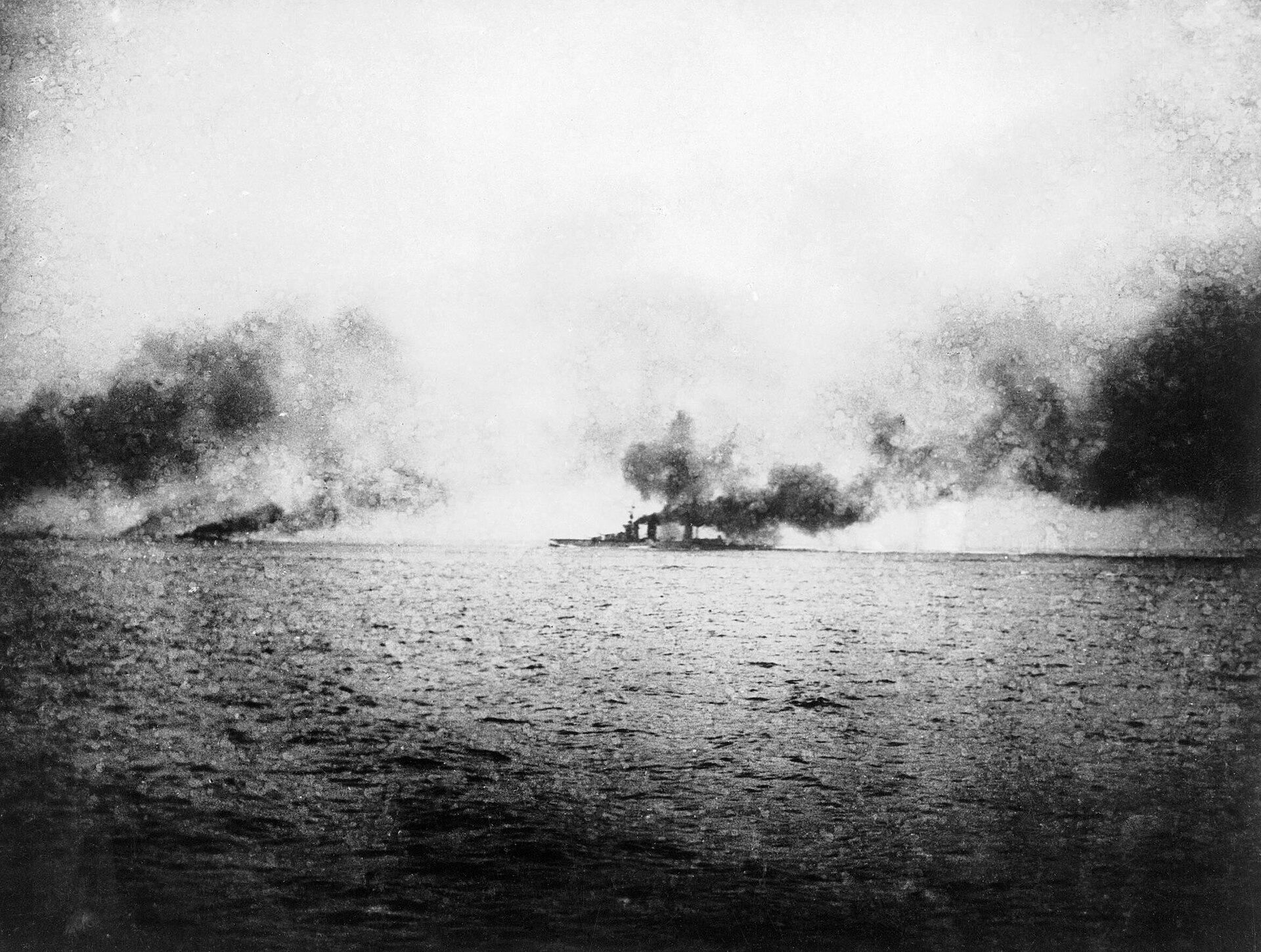
Historical context
The British Grand Fleet and German High Seas Fleet met in the North Sea on 31 May and 1 June 1916. Battlecruiser actions were followed by encounters between the main battle fleets before the German fleet withdrew.
Britain lost more ships and men in the action, but the Royal Navy retained strategic control of the North Sea and maintained the blockade of Germany. The battle remained the war's principal clash between dreadnought fleets.
World History Database records
The records below are selected from the 572-record World War I battles archive and rendered as static HTML in chronological order.
Battle of Jutland
Beatty sails from Rosyth with six battlecruisers and the four fast battleships of the Fifth Battle Squadron.
Battle of Jutland
British and German scouting forces make contact, drawing Beatty's and Hipper's battlecruisers toward battle.
Battle of Jutland
Leads 5 cruisers along the Jutland Peninsula to break the British North Sea blockade. Hipper & Beattys destroyers see each other & the Germans entice the British fleet. Germans have 16 Dreadnoughts, 6 pre-Dreadnoughts, 11 light cruisers & 72 destroyers
Battle of Jutland
Commands the Grand Fleet in the Battle of Jutland
Battle of Jutland
Intends to entice British battle-cruisers offf the Norwegian coast & destroy them. Follows von Hipper with the German Fleet of 99 ships along the Jutland Peninsula
Battle of Jutland
Commands the 2nd Cruiser Squadron at the Battle of Jutland
Battle of Jutland
Commands the Colossus during the Battle of Jutland
Battle of Jutland
Scheer is outgunned by Jellicoes fleet & turns away under cover of smokescreens. Learns of the movement of the German Fleet along the Jutland Peninsula & mobilizes. Britain claims victory because the German Fleet stays in its harbour during the war
Battle of Jutland
Sails from Scapa Flow with 28 Dreadnoughts & 3 Battle cruisers
Battle of Jutland
The Germans claim a victory because they have sunk more ships than they have lost. The German Fleet retrurns to port & does not break out again during the war. Scheer is outgunned by Jellicoes fleet & turns away under cover of smokescreens. Both sides lose 6 ships but the British lose greater tonnage
Battle of Jutland
The Commander of the 4th Battle Squadron at the Battle of Jutland
Battle of Jutland
Sees service at the Battle of Jutland
Editorial provenance
Compiled and edited by World History Database.
Historical context is editorial material; the chronology is generated from World History Database First World War records.
Last reviewed: September 2026.
Imperial War Museums · Commonwealth War Graves Commission · Australian War Memorial
Continue exploring