1941
Battle of Stalingrad
Advises Hitler the Luftwaffe can keep the Army supplied in Stalingrad, a mistake
Second World War · permanent subject timeline
The destructive urban battle and encirclement on the Volga. This page combines historical context with 71 matching records drawn directly from the World History Database World War II battle archive.
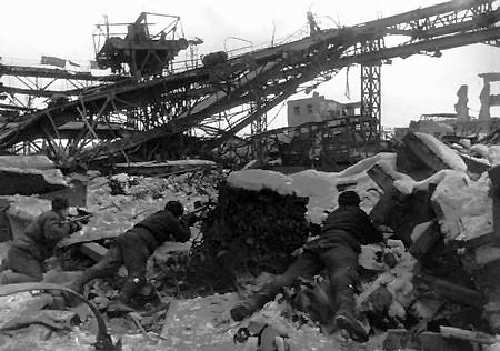
Historical context
German and Soviet forces fought for Stalingrad through the second half of 1942. In November the Red Army launched Operation Uranus against weaker Axis forces on the flanks and encircled the German Sixth Army.
The surrender of the Sixth Army in February 1943 was a major strategic and psychological defeat for Germany. The battle marked a crucial stage in the shift of the Eastern Front's initiative toward the Soviet Union.
World History Database records
The records below are selected from the 797-record World War II battles archive and rendered as static HTML in chronological order.
Battle of Stalingrad
Advises Hitler the Luftwaffe can keep the Army supplied in Stalingrad, a mistake
Battle of Stalingrad
Orders the Stalingrad Defence Committee to prepare the city for war immediately
Battle of Stalingrad
Bock has been dismissed & Paulus placed in charge of capturing Stalingrad
Battle of Stalingrad
The splitting of Army Group South enabled the launching of Operation Edelweiss and Operation Fischreiher, the two main thrusts of the Army Groups. Both groups had to achieve their objectives simultaneously.
Battle of Stalingrad
The success of the initial advance was such that Hitler ordered the 4th Panzer Army south to assist the First Panzer Army to cross the lower Don river.
Battle of Stalingrad
This assistance was not needed and Kleist later complained that 4th Panzer Army clogged the roads and that if they had carried on toward Stalingrad, they could have taken it in July.
Battle of Stalingrad
When it turned north again two weeks later, the Soviets had gathered enough forces together at Stalingrad to check its advance
Battle of Stalingrad
Reaches Kotelnikovo 125 miles south west of Stalingrad
Battle of Stalingrad
Helps capture Kalach near Stalingrad
Battle of Stalingrad
Placed in full charge of capturing Stalingrad after the dismissal of Bock
Battle of Stalingrad
Moved up to the north-west Front
Battle of Stalingrad
Helps capture Kalach near Stalingrad
Battle of Stalingrad
Arrives in Stalingrad to assume command
Battle of Stalingrad
The Swastika is raised over Mount Elbrus
Battle of Stalingrad
Leads the 16th Panzer Division across the River Don
Battle of Stalingrad
The 6th Army crossed the Don and Army Group B established a defensive line on one of its bends.The 6th Army reached the northern suburbs of Stalingrad later that day, beginning the Battle of Stalingrad
Battle of Stalingrad
The 6th Army reach the Volga north of Stalingrad
Battle of Stalingrad
After the Luftwaffe attack Stalingrad & kill 40,000 Pauluss 6th Army attack
Battle of Stalingrad
Attacks Stalingrad from the south West
Battle of Stalingrad
The Russians outflank & encircle the German 6th, 9th & 4th Panzer Armies
Battle of Stalingrad
Gathers 190,000 men, 350 tanks, 340 planes & 8,000 guns on the Staingrad front
Battle of Stalingrad
After defeating the last Soviet counter-attacks, 6th Army resumed its offensive on 2 September, linking up with 4th Panzer Army the following day. On 12 September, the Germans entered Stalingrad
Battle of Stalingrad
Chuikov had witnessed firsthand the blitzkrieg tactics the Nazis had used to sweep across the Russian steppe, so he used the Germans carpet-bombing of the city to draw panzer units into the rubble and chaos, where their progress was impeded.
Battle of Stalingrad
Here they could be destroyed with Molotov cocktails and Russian artillery operating at close range. This tactic also rendered the German Luftwaffe ineffective, since Stuka dive-bombers could not attack Red Army positions without endangering their own forces
Battle of Stalingrad
It was at Stalingrad that Chuikov developed the important tactic of hugging the enemy, Guerrilla warfare, by which under-armed Soviet soldiers kept the German army so close to them as to minimize the superior firepower enjoyed by the Wehrmacht.
Battle of Stalingrad
Put in charge of defending Stalingrad.
Battle of Stalingrad
Advances across the Volga into the southernmost suburb of Stalingrad
Battle of Stalingrad
Most of Stalingrad is captured but the 6th Armys flanks are exposed
Battle of Stalingrad
Crushes the Romanians & begins to entrap von Pauluss Army
Battle of Stalingrad
3rd Romanian Army had been transferred from Caucasus on 10 September, to take over Italian positions on the Don, opposite the Soviet bridgeheads. The Romanians were understrength and had only around six modern anti-tank guns per division.
Battle of Stalingrad
3rd Romanian Army, on the Don River west of Stalingrad, and 4th Romanian Army, south-east of Stalingrad, had been under constant Soviet attack since September.
Battle of Stalingrad
Hitler ordered 6th Army to remain on the defensive, rather than try to break out. It was intended the army would be supplied by air, but the quantity of supplies necessary was far beyond the ability of the Luftwaffe to carry. 6th Armys strength diminished and the Soviets gained the upper hand inside the city. Hitler forbids any retreat or surrender, they are "liquidated" by 25 January 1943
Battle of Stalingrad
The Soviets launched Operation Uranus, a two-pronged counter-offensive against the flanks of 6th Army. With the battle for the city and the exhaustion of 4th Panzer Army, the flanks were mainly guarded by Romanian, Hungarian and Italian soldiers.
Battle of Stalingrad
The bulk of the German tank reserve, the 48th Panzer Corps, consisted of about 180 tanks, half being obsolete Panzer 35(t)s. The two Romanian armies were routed and 6th Army, with parts of 4th Panzer Army, were encircled in Stalingrad.
Battle of Stalingrad
The Red Army begins to encircle the German forces besieging Stalingrad
Battle of Stalingrad
Leads the attack on the north & south flanks of the Germans
Battle of Stalingrad
The 6th Army is completely encircled by the Red Army
Battle of Stalingrad
Captures the supply bridge at Kalach
Battle of Stalingrad
The Stalingrad fronts link up, 330,000 Germans are encircled. Hitler orders the 6th Army to hold their position
Battle of Stalingrad
The south west & Stalingrad fronts link up, 330,000 Germans are encircled. Hitler orders "Where the German Soldier sets his foot, there he remains"
Battle of Stalingrad
Zhukov begins attacking the German 5th Army & 4th Panzer Army in the rear. The 300,000 force of the German 6th Army is encircled
Battle of Stalingrad
Following the success of Operation Uranus, the Red Army began Operation Saturn, to cut off Army Group A and all troops east of Rostov.During the German relief operation at Stalingrad, Soviet forces had been redeployed, lesser objectives substituted, and the operation renamed "Little Saturn".
Battle of Stalingrad
Spearheaded by some of the first Tiger tanks, the offensive got within 48 km (30 mi) of the southern 6th Army front, but the Germans made no attempt to break out.
Battle of Stalingrad
The attack fell on Eighth Italian Army and the remnants of 3rd Romanian Army, and led to the destruction of most of Eighth Army. A relief operation called Operation Winter Storm began.
Battle of Stalingrad
The failure was followed by a siege that lasted for almost three months, during which 6th Army was destroyed
Battle of Stalingrad
Sets the Panzers rolling to relieve Paulus trapped 6th Army. Manstein is 30 miles away from Stalingrad
Battle of Stalingrad
Zhukov drives Hoths army back across Kotelnikov
Battle of Stalingrad
Zhukov drives the Germans back from the north & sth. Supply lines can no longer reach Paulus on land
Battle of Stalingrad
Zhukov drives the German forces in the north beyond the Chir & Aksay. Zhukov drives Hoths army back across Kotelnikov
Battle of Stalingrad
Claims the Luftwaffe can supply the encircled German army at Stalingrad by air
Battle of Stalingrad
Commands the 4th Panzer Army at the Battle of Stalingrad
Battle of Stalingrad
The Russians outflank & encircle the German 6th, 9th & 4th Panzer Armies. Commands Russian forces on the Don River Front
Battle of Stalingrad
Rokossovsky sends in a request for the German 6th Army to surrender, this is refused
Battle of Stalingrad
Rokossovsky sends in a request for the German 6th Army to surrender, this is refused
Battle of Stalingrad
The 65th Army advances 5 miles in the first day
Battle of Stalingrad
Put in command of the air supply of Stalingrad by Hitler, Goerings deputy
Battle of Stalingrad
The last German airfield at Gumrak is captured
Battle of Stalingrad
The last German airfield at Gumrak is captured
Battle of Stalingrad
The Russians offer Paulus the chance to surrender but Hitler rejects the offer
Battle of Stalingrad
The Russians offer Paulus the chance to surrender but Hitler rejects the offer
Battle of Stalingrad
Makes Paulus Field Marshal because a German Field Marshal has never been captured
Battle of Stalingrad
Hitler promotes Paulus to Field Marshal because no Field Marshal has ever surenderred
Battle of Stalingrad
Paulus, with 25 other generals, surrenders to the Russians
Battle of Stalingrad
The Germans have lost 600,000 & the Russians 400,000. Paulus surrenders the 6th Army at the Battle of Stalingrad
Battle of Stalingrad
The Germans under Paulus surrender Stalingrad to Rokossovsky
Battle of Stalingrad
Paulus surrenders the German 6th Army. During the battle the Germans lose 600,000 & the Russians 400,000
Battle of Stalingrad
The German 6th Army surrenders. Since Zhkovs counter-attack 32 Axis Divisions & 3 Axis Brigades have been destroyed
Battle of Stalingrad
Personally accepts the surrender of Marshal Paulus & his 6th Army
Battle of Stalingrad
The remainder of the German forces in Stalingrad lay down their arms
Battle of Stalingrad
The remainder of the German forces in Stalingrad lay down their arms
Battle of Stalingrad
The disaster at Stalingrad was the end of Case Blue and the territorial gains had been reversed by the end of 1943, except for the Kuban bridgehead on the Taman peninsula, retained for a possible second offensive to the Caucasus, which was held until 9 October 1943
Editorial provenance
Compiled and edited by World History Database.
Historical context is editorial material; the chronology is generated from World History Database Second World War records.
Last reviewed: September 2026.
Imperial War Museums · National WWII Museum · Australian War Memorial
Continue exploring