1917 10th February
Bolshevik Party
The Bolsheviks call a strike in Petrograd to protest the 1915 arrest of their Duma members for opposing the war
Russian Revolution · permanent subject timeline
Mass protest, military mutiny and the collapse of tsarist rule. This page combines historical context with 44 matching records drawn directly from the World History Database Russian Revolution collection.
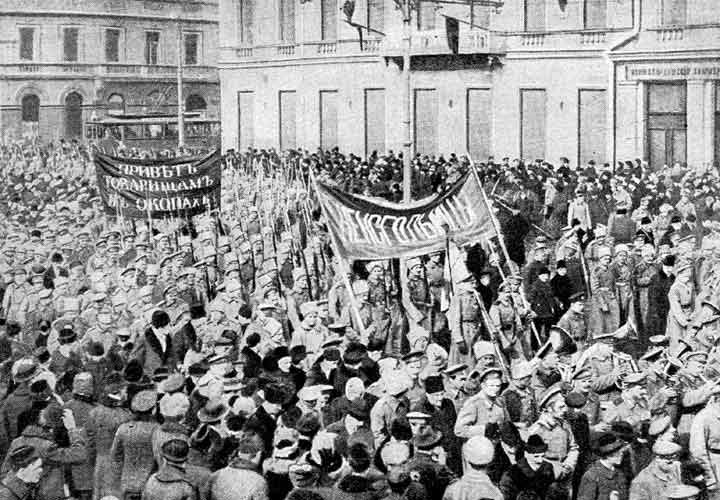
Historical context
The February Revolution began with strikes, food protests and demonstrations in Petrograd and escalated when soldiers refused orders to suppress the crowds. Within days the imperial government lost control of the capital, a provisional political authority emerged and Nicholas II abdicated.
The February Revolution ended Romanov autocracy but did not settle who should govern Russia. It produced the unstable relationship between the Provisional Government and the Petrograd Soviet that shaped the rest of 1917.
World History Database records
The records below are selected from the 726-record Russian Revolution collection and rendered as static HTML for reading and indexing.
Bolshevik Party
The Bolsheviks call a strike in Petrograd to protest the 1915 arrest of their Duma members for opposing the war
Duma
The Bolsheviks call a strike in Petrograd to protest the 1915 arrest of their Duma members for opposing the war
Rebellion
The Bolsheviks call a strike in Petrograd to protest the 1915 arrest of their Duma members for opposing the war
Rebellion
The Councillor of State Mikhail Rodzianko meets with Tsar Nicholas II in Tsarskoye Selo, and warns him of massive upheavel throughout the country, Rodzianko insists that tumultuous events can be avoided by stregthening the Duma
Duma
The Duma opens in the halls of Taurida, Petrograd
Demonstrations
The Tsarleaves Moscow for Mogliev, the security of Moscow is entrusted to Beliaev
Demonstrations
Demonstrations pass off peacefully. Balk observes that the Cossacks are reluctant to confront the crowds
Bolshevik Party
Calls for the re-unification of the Bolsheviks & Mensheviks
Demonstrations
Calls for the re-unification of the Bolsheviks & Mensheviks. Calls for an end to the war & for revolution
February Revolution
The Litovsky and Preobrazhensky Regiments join a new rebel army and storm the Main Arsenal liberating 40,000 rifles and liberate political prisoners from Kresty jail. General Khabalovs soldiers, acting under the Tsars orders, open fire on striking workers, 169 workers are killed, and over 1,000 people are injured
Menshevik Party
Calls for the re-unification of the Bolsheviks & Mensheviks
Strike
General Khabalovs soldiers, acting under the Tsars orders, open fire on striking workers, 169 workers are killed, and over 1,000 people are injured
Demonstrations
Ordered by Nicholas II to use force on the Petrograd demonstrators
Demonstrations
Petrograd is occupied by military units in combat gear & a curfew imposed
Demonstrations
The Volynskii Regiment fires on the crowd killing 40
Warning to Nicholas II
Rodzianko warns Nicholas II that unrest in Petrograd is becoming critical and urges immediate political concessions.
Demonstrations
Nicholas II orders General Ivanov to suppress the disorder
Demonstrations
Khabalov has only 2,000 loyal troops as Petrograd is taken over by peasant soldiers
Duma
Rodzianko asks the Duma to convene to resolve on a course of action, the group creates a Provisional Committee, which urgently asks the Tsar to save himself by sharing power with a Prime Minister, the Tsar refuses
Election
Factory and military delegates begin forming the Petrograd Soviet.
February Revolution
Supports the Duma committee as the monarchy collapses.
February Revolution
Rodzianko asks the Duma to convene to resolve on a course of action, the group creates a Provisional Committee, which urgently asks the Tsar to save himself by sharing power with a Prime Minister, the Tsar refuses
February Revolution Leadership
Plays a leading role during the February Revolution, helping establish the revolutionary authorities that replace the Romanov monarchy.
Formation of Duma Provisional Committee
Rodzianko chairs the Provisional Committee of the State Duma as imperial authority collapses in Petrograd.
Menshevik Party
Menshevik influence shapes the early Petrograd Soviet leadership.
Petrograd Soviet
Helps organise the Soviet as revolutionary authority emerges.
Petrograd Soviet
Bridges the Duma committee and the new Soviet leadership.
Petrograd Soviet
Joins the Soviet leadership during the February Revolution.
Petrograd Soviet
Records the formation of the Petrograd Soviet from inside revolutionary circles.
Petrograd Soviet Elections
Menshevik leaders call for elections to the Petrograd Soviet.
Petrograd Soviet Organisation
Skobelev joins the Soviet leadership as workers and soldiers create new institutions.
Petrograd Soviet Role
Kerensky connects the Duma committee with the newly formed Petrograd Soviet.
Provisional Committee
Rodzianko asks the Duma to convene to resolve on a course of action, the group creates a Provisional Committee, which urgently asks the Tsar to save himself by sharing power with a Prime Minister, the Tsar refuses
Rebellion
Khabalov has only 2,000 loyal troops as Petrograd is taken over by peasant soldiers
Strike
Khabalov has only 2,000 loyal troops as Petrograd is taken over by peasant soldiers
Dual Power
The Duma committee must coexist with the Petrograd Soviet.
Executive Committee
Chairs the Soviet Executive Committee during the revolution.
Abdication
Supervises the Tsars abdication
February Revolution
The first Joint Plenum of the Soviet of Workers and Soldiers Deputies issues Soviet Order No. 1: all soldiers units will elect Soldiers Committee's & the decree stipulates that soldiers will now accept orders from the Soldiers Soviet
Abdication of Nicholas II
Nicholas II signs his abdication, ending his reign as the monarchy collapses during the February Revolution.
Exile of Joseph Stalin
Released by the February Revolution from exile in Turukhansk, arrives in Petrograd
Coup
After the Russian monarchy was overthrown during the February Revolution, returns to Russia in a sealed train with Lenin and other revolutionaries opposed to the war
Exile of Grigory Yevseyevich Zinoviev
After the Russian monarchy was overthrown during the February Revolution, returns to Russia in a sealed train with Lenin and other revolutionaries opposed to the war
Coup
Opposes the Bolshevik armed uprising. After the Russian monarchy was overthrown during the February Revolution, returns to Russia in a sealed train with Lenin and other revolutionaries opposed to the war. Favours broad socialist coalition Government after the October Revolution
Editorial provenance
Compiled and edited by World History Database
Historical context is editorial material; the chronology is generated from World History Database Russian Revolution records.
Last reviewed: September 2026.
Continue exploring