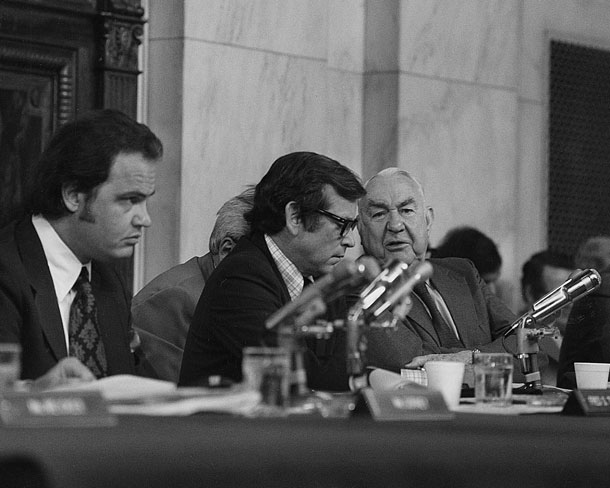
Samuel J. Ervin Jr. of North Carolina chaired the Senate Select Committee on Presidential Campaign Activities, commonly called the Senate Watergate Committee.
The committee investigated the Watergate break-in, the subsequent cover-up, political espionage and campaign-finance practices. These records follow Ervin’s role through the 1973 public hearings and the committee’s 1974 conclusion.
31 selected database records
Howard Baker and Sam Ervin during the 1973 Senate Watergate hearings. U.S. Senate Historical Office; public domain. Image source
The record cards below are rendered directly in this page’s HTML. They are selected from the World History Database Watergate dataset; the source links beneath each record group provide authoritative context for the chronology.
1973
29 records
Senator Samuel James ErvinSenate Watergate Committee Chairman
Watergate Committee Created
Becomes chairman of the Senate Select Committee on Presidential Campaign Activities, created to investigate Watergate, campaign espionage and related abuses.
WashingtonPoliticsWatergateRange: 1972-1974
Senator Samuel James ErvinSenate Watergate Committee Chairman
Public Watergate Hearings
Opens the Senate Watergate Committee's public hearings, beginning months of nationally televised testimony about the burglary, campaign abuses and cover-up.
WashingtonPoliticsWatergateRange: 1972-1974
Senator Samuel James ErvinSenate Watergate Committee Chairman
Caulfield and Ulasewicz Testimony
Oversees testimony from John Caulfield and Anthony Ulasewicz concerning investigative and political activities connected with the developing Watergate inquiry.
WashingtonPoliticsWatergateRange: 1972-1974
Senator Samuel James ErvinSenate Watergate Committee Chairman
Harmony and Reisner Testimony
Leads a public hearing featuring Sally Harmony and Robert Reisner as the committee develops evidence about campaign organization and Watergate-related activities.
WashingtonPoliticsWatergateRange: 1972-1974
Senator Samuel James ErvinSenate Watergate Committee Chairman
Sloan and Porter Testimony
Presides as Hugh Sloan and Herbert Porter testify about campaign operations, finances and conduct connected with the Committee for the Re-Election of the President.
WashingtonPoliticsWatergateRange: 1972-1974
Senator Samuel James ErvinSenate Watergate Committee Chairman
Maurice Stans Testimony
Oversees testimony from Maurice Stans as the committee examines campaign finance practices and the handling of money associated with Nixon's reelection organization.
WashingtonPoliticsWatergateRange: 1972-1974
Senator Samuel James ErvinSenate Watergate Committee Chairman
Phase I Evidence Review
Leads another public session as the committee continues building its evidentiary record on the burglary, campaign activities and subsequent efforts to conceal responsibility.
WashingtonPoliticsWatergateRange: 1972-1974
Senator Samuel James ErvinSenate Watergate Committee Chairman
John Dean Testimony Begins
Presides as former White House counsel John Dean begins major testimony describing Watergate-related events and alleging a widening effort inside the administration to conceal them.
WashingtonPoliticsWatergateRange: 1972-1974
Senator Samuel James ErvinSenate Watergate Committee Chairman
White House Staff Inquiry
Guides renewed Phase I hearings examining White House staff conduct and the relationship between presidential aides, campaign operations and Watergate-related activities.
WashingtonPoliticsWatergateRange: 1972-1974
Senator Samuel James ErvinSenate Watergate Committee Chairman
Cover-Up Testimony Review
Presides over further testimony concerning the alleged Watergate cover-up and the conduct of officials linked to the White House and reelection campaign.
WashingtonPoliticsWatergateRange: 1972-1974
Senator Samuel James ErvinSenate Watergate Committee Chairman
White House Tape Subpoena
Leads the committee as it votes unanimously to subpoena presidential recordings and documents that could test conflicting Watergate testimony.
WashingtonPoliticsWatergateRange: 1972-1974
Senator Samuel James ErvinSenate Watergate Committee Chairman
Taping Evidence Follow-Up
Directs the committee's follow-up after disclosure of the White House taping system while hearings continue into presidential aides and Watergate-related financial and political activities.
WashingtonPoliticsWatergateRange: 1972-1974
Senator Samuel James ErvinSenate Watergate Committee Chairman
Presidential Aides Hearing
Presides over another Watergate hearing examining the actions of presidential aides and the relationship between White House operations and the reelection campaign.
WashingtonPoliticsWatergateRange: 1972-1974
Senator Samuel James ErvinSenate Watergate Committee Chairman
Presidential Tape Subpoena Served
Directs the committee as its subpoena for specified presidential recordings and documents is delivered to the White House after the discovery of Nixon's recording system.
WashingtonPoliticsWatergateRange: 1972-1974
Senator Samuel James ErvinSenate Watergate Committee Chairman
Ehrlichman Examination Continues
Leads continuing examination of John Ehrlichman as the committee explores White House investigative operations, presidential staff conduct and disputed Watergate-related decisions.
WashingtonPoliticsWatergateRange: 1972-1974
Senator Samuel James ErvinSenate Watergate Committee Chairman
Phase I Senior Aides Inquiry
Presides over another Phase I session examining evidence concerning senior presidential aides and their roles in events surrounding Watergate and its aftermath.
WashingtonPoliticsWatergateRange: 1972-1974
Senator Samuel James ErvinSenate Watergate Committee Chairman
Haldeman Testimony Continues
Presides as H. R. Haldeman continues testimony about White House operations, presidential conversations and events central to the committee's Watergate investigation.
WashingtonPoliticsWatergateRange: 1972-1974
Senator Samuel James ErvinSenate Watergate Committee Chairman
Watergate Evidence Consolidation
Leads another Phase I session as the committee consolidates testimony on campaign misconduct, White House involvement and efforts to obstruct or limit investigation.
WashingtonPoliticsWatergateRange: 1972-1974
Senator Samuel James ErvinSenate Watergate Committee Chairman
Senate Watergate Lawsuit
Leads the committee when it files a federal lawsuit seeking judicial enforcement of its demand for Nixon's tapes and other presidential materials.
WashingtonPoliticsWatergateRange: 1972-1974
Senator Samuel James ErvinSenate Watergate Committee Chairman
September Watergate Hearings Resume
Presides as the committee resumes public Watergate hearings after the summer sessions, continuing its examination of evidence gathered during the investigation.
WashingtonPoliticsWatergateRange: 1972-1974
Senator Samuel James ErvinSenate Watergate Committee Chairman
Campaign Practices Phase Opens
Leads the committee as hearings move into the campaign-practices phase, broadening the inquiry beyond the burglary to political intelligence and election conduct.
WashingtonPoliticsWatergateRange: 1972-1974
Senator Samuel James ErvinSenate Watergate Committee Chairman
Political Intelligence Hearing
Presides over campaign-practices testimony concerning political intelligence, campaign conduct and activities investigated as part of the broader Watergate inquiry.
WashingtonPoliticsWatergateRange: 1972-1974
Senator Samuel James ErvinSenate Watergate Committee Chairman
Campaign Practices Evidence Review
Leads continued Phase II testimony as the committee reviews evidence about campaign practices and political operations connected with the 1972 election.
WashingtonPoliticsWatergateRange: 1972-1974
Senator Samuel James ErvinSenate Watergate Committee Chairman
Campaign Practices November Hearing
Presides over a November Phase II session continuing the committee's examination of campaign practices and election-related political operations.
WashingtonPoliticsWatergateRange: 1972-1974
Senator Samuel James ErvinSenate Watergate Committee Chairman
Campaign Financing Phase Opens
Leads the opening of Phase III hearings devoted to campaign financing, expanding the committee's public inquiry into fundraising and financial practices surrounding the 1972 election.
WashingtonPoliticsWatergateRange: 1972-1974
Senator Samuel James ErvinSenate Watergate Committee Chairman
Campaign Finance Evidence Hearing
Presides over continued campaign-finance hearings as the committee examines contributions, fundraising arrangements and financial evidence developed during its investigation.
WashingtonPoliticsWatergateRange: 1972-1974
Senator Samuel James ErvinSenate Watergate Committee Chairman
Campaign Financing Public Hearings Continue
Leads another public session examining campaign financing and the committee's accumulated evidence about fundraising practices and political contributions.
WashingtonPoliticsWatergateRange: 1972-1974
Senator Samuel James ErvinSenate Watergate Committee Chairman
Milk Fund Executive Testimony
Oversees executive-session testimony in the Milk Fund investigation as the committee examines financial and political relationships connected with campaign contributions.
WashingtonPoliticsWatergateRange: 1972-1974
Senator Samuel James ErvinSenate Watergate Committee Chairman
Milk Fund Investigation Continues
Leads another closed committee session examining evidence gathered in the Milk Fund investigation and questions concerning political contributions.
Senator Samuel James ErvinSenate Watergate Committee Chairman
Watergate Public Hearings End
Joins a unanimous committee decision to end public Watergate hearings and complete remaining work privately while criminal and impeachment proceedings continue.
WashingtonPoliticsWatergateRange: 1972-1974
Senator Samuel James ErvinSenate Watergate Committee Chairman
Watergate Committee Final Report
Submits the Senate Watergate Committee's final report with recommendations on campaign finance, a permanent special prosecutor and congressional legal authority.
The explanatory text and major chronology on this page were cross-checked against the following institutional sources. Individual database records may contain additional detail from the wider World History Database dataset.