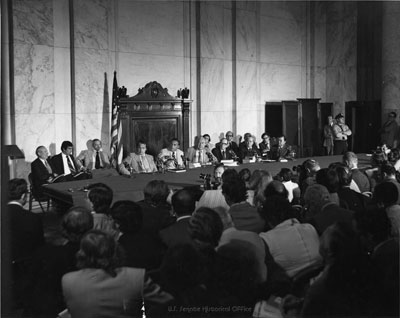
The United States Senate created the Select Committee on Presidential Campaign Activities on 7 February 1973 to investigate the 1972 presidential campaign, the Watergate break-in, the cover-up and related campaign practices.
Senator Sam J. Ervin Jr. chaired the committee and Senator Howard H. Baker Jr. served as vice chairman. Public hearings began on 17 May 1973, and the committee issued its final report on 27 June 1974.
50 selected database records
Senate Watergate Committee hearing, 1973. U.S. Senate Historical Office; public domain. Image source
The record cards below are rendered directly in this page’s HTML. They are selected from the World History Database Watergate dataset; the source links beneath each record group provide authoritative context for the chronology.
1973
49 records
Senator Samuel James ErvinSenate Watergate Committee Chairman
Watergate Committee Created
Becomes chairman of the Senate Select Committee on Presidential Campaign Activities, created to investigate Watergate, campaign espionage and related abuses.
WashingtonPoliticsWatergateRange: 1972-1974
Harry Robbins "Bob" HaldemanWhite House Chief of Staff
Senate Watergate Investigation Planning
Discusses with Nixon the developing Senate Watergate investigation, John Dean's activities, minority counsel arrangements and possible White House responses.
Judge Sirica urged Mc Cord to cooperate fully with the Senate Watergate Committee, which was about to begin its investigation.
PoliticsWatergateRange: 1960-1975
President of United States of America Richard Milhous NixonPresident of USA
Senate Watergate Committee
Senate Watergate Committee lawyer Sam Dash told reporters that he had interviewed James McCord twice, and that McCord had "named names" and had begun supplying a full and honest accounts of the Watergate operation.
Leaks following McCord's closed Senate testimony contribute to the committee's decision to conduct later Watergate hearings in public.
PoliticsWatergate
James W. McCord Jr.
Senate Watergate Committee
McCord tells Senate investigators that G. Gordon Liddy said John Mitchell had approved the burglary and surveillance operation.
PoliticsWatergate
James W. McCord Jr.
Senate Watergate Committee
McCord testifies for about five hours in a closed session of the Senate Watergate Committee.
PoliticsWatergate
President of United States of America Richard Milhous NixonPresident of USA
Senate Watergate Committee
James McCord testified before the Senate Watergate Committee in a closed 5-hour session. There were so many leaks to the press that committee leaders decided to conduct all future hearings in public session.
President of United States of America Richard Milhous NixonPresident of USA
Senate Watergate Committee
President Nixon made a brief statement before the White House Press Corps that his White House aides and staff would appear before the Senate Watergate Committee if asked.
Senator Samuel James ErvinSenate Watergate Committee Chairman
Public Watergate Hearings
Opens the Senate Watergate Committee's public hearings, beginning months of nationally televised testimony about the burglary, campaign abuses and cover-up.
WashingtonPoliticsWatergateRange: 1972-1974
Archibald Cox
Senate Watergate Committee
The Senate Watergate committee begins its nationally televised hearings. Attorney General-designate Elliot Richardson taps former solicitor general Archibald Cox as the Justice Department’s special prosecutor for Watergate.
PoliticsWatergate
Senator Howard Henry BakerSenate Watergate Committee Vice Chairman
James McCord Testimony
Questions James McCord during the second day of public hearings as the committee examines the Watergate break-in, wiretapping and efforts to conceal responsibility.
WashingtonPoliticsWatergateRange: 1972-1974
Senator Howard Henry BakerSenate Watergate Committee Vice Chairman
Barker and Baldwin Testimony
Participates as the committee hears Gerald Alch, Bernard Barker and Alfred Baldwin during continuing testimony about the burglary operation and its participants.
WashingtonPoliticsWatergateRange: 1972-1974
Senator Howard Henry BakerSenate Watergate Committee Vice Chairman
Campaign Organization Inquiry
Participates in the continuing Phase I hearings as the committee examines the structure, personnel and activities of the Nixon reelection campaign.
WashingtonPoliticsWatergateRange: 1972-1974
Senator Samuel James ErvinSenate Watergate Committee Chairman
Maurice Stans Testimony
Oversees testimony from Maurice Stans as the committee examines campaign finance practices and the handling of money associated with Nixon's reelection organization.
WashingtonPoliticsWatergateRange: 1972-1974
Senator Howard Henry BakerSenate Watergate Committee Vice Chairman
Campaign Finance Examination
Takes part in a Phase I hearing focused on campaign finances, fundraising practices and evidence being developed through the committee's Watergate investigation.
WashingtonPoliticsWatergateRange: 1972-1974
Senator Samuel James ErvinSenate Watergate Committee Chairman
John Dean Testimony Begins
Presides as former White House counsel John Dean begins major testimony describing Watergate-related events and alleging a widening effort inside the administration to conceal them.
WashingtonPoliticsWatergateRange: 1972-1974
John DeanFormer White House Counsel
Senate Watergate Committee
Begins televised testimony with a lengthy opening statement describing White House efforts to contain the scandal and implicating senior administration officials.
WashingtonPoliticsWatergateRange: 1972-1974
Senator Howard Henry BakerSenate Watergate Committee Vice Chairman
John Dean Testimony Continues
Questions John Dean as his nationally broadcast testimony continues, testing Dean's account of White House knowledge, meetings and actions connected with the Watergate cover-up.
WashingtonPoliticsWatergateRange: 1972-1974
Senator Howard Henry BakerSenate Watergate Committee Vice Chairman
Presidential Staff Evidence
Participates as the committee continues questioning witnesses about White House staff involvement, campaign intelligence operations and the developing cover-up allegations.
WashingtonPoliticsWatergateRange: 1972-1974
Senator Samuel James ErvinSenate Watergate Committee Chairman
Cover-Up Testimony Review
Presides over further testimony concerning the alleged Watergate cover-up and the conduct of officials linked to the White House and reelection campaign.
WashingtonPoliticsWatergateRange: 1972-1974
Alexander ButterfieldFormer White House Aide
Taping System Testimony
Publicly confirms before the Senate Watergate Committee that presidential conversations were automatically recorded in several White House locations.
WashingtonPoliticsWatergateRange: 1972-1974
President of United States of America Richard Milhous NixonPresident of USA
White House Taping System
Ends operation of the remaining White House recording system after Alexander Butterfield publicly discloses its existence to the Senate Watergate Committee.
Senator Samuel James ErvinSenate Watergate Committee Chairman
Taping Evidence Follow-Up
Directs the committee's follow-up after disclosure of the White House taping system while hearings continue into presidential aides and Watergate-related financial and political activities.
WashingtonPoliticsWatergateRange: 1972-1974
Senator Howard Henry BakerSenate Watergate Committee Vice Chairman
Phase I White House Inquiry
Participates in continuing Phase I testimony as the committee investigates White House involvement, campaign activities and the implications of the newly disclosed presidential recording system.
WashingtonPoliticsWatergateRange: 1972-1974
Senator Howard Henry BakerSenate Watergate Committee Vice Chairman
Executive Branch Evidence Hearing
Takes part as the committee continues assembling testimony about executive branch actions, campaign intelligence and the handling of information after the Watergate arrests.
WashingtonPoliticsWatergateRange: 1972-1974
President of United States of America Richard Milhous NixonPresident of USA
Watergate
Nixon refuses to turn over the presidential tape recordings to the Senate Watergate committee or the special prosecutor.
President of United States of America Richard Milhous NixonPresident of USA
White House Tapes
Refuses to provide presidential recordings to the Senate Watergate Committee or Special Prosecutor Archibald Cox, invoking executive privilege and separation of powers.
Senator Samuel James ErvinSenate Watergate Committee Chairman
Ehrlichman Examination Continues
Leads continuing examination of John Ehrlichman as the committee explores White House investigative operations, presidential staff conduct and disputed Watergate-related decisions.
WashingtonPoliticsWatergateRange: 1972-1974
Senator Howard Henry BakerSenate Watergate Committee Vice Chairman
Ehrlichman Hearing Continues
Questions and evaluates continuing testimony from John Ehrlichman as the committee develops its record concerning White House operations and the Watergate cover-up.
WashingtonPoliticsWatergateRange: 1972-1974
Senator Howard Henry BakerSenate Watergate Committee Vice Chairman
Haldeman Testimony Begins
Participates as former White House chief of staff H. R. Haldeman begins testimony, bringing one of Nixon's closest former aides before the televised Watergate hearings.
WashingtonPoliticsWatergateRange: 1972-1974
Senator Howard Henry BakerSenate Watergate Committee Vice Chairman
Late Phase I Hearing
Participates as the committee continues its late Phase I hearings, reviewing testimony and evidence concerning White House and campaign conduct.
WashingtonPoliticsWatergateRange: 1972-1974
Senator Howard Henry BakerSenate Watergate Committee Vice Chairman
Phase I Closing Testimony
Participates in further Phase I testimony as the committee approaches the end of its initial public examination of the burglary and related cover-up.
WashingtonPoliticsWatergateRange: 1972-1974
Everette Howard HuntWatergate Witness
Senate Watergate Testimony Begins
Hunt testified publicly before the Senate Watergate Committee about his CIA background, White House assignments, political intelligence work, and the Watergate break-ins.
WashingtonPoliticsWatergateOffice: 1973-1973
Senator Samuel James ErvinSenate Watergate Committee Chairman
September Watergate Hearings Resume
Presides as the committee resumes public Watergate hearings after the summer sessions, continuing its examination of evidence gathered during the investigation.
WashingtonPoliticsWatergateRange: 1972-1974
Everette Howard HuntWatergate Witness
Senate Watergate Testimony Continues
Hunt continued answering Senate questions about Charles Colson, G. Gordon Liddy, campaign intelligence operations, and his understanding of White House authority.
WashingtonPoliticsWatergateOffice: 1973-1973
Senator Howard Henry BakerSenate Watergate Committee Vice Chairman
Campaign Practices Inquiry
Participates in Phase II hearings examining campaign practices associated with the 1972 presidential election and evidence gathered by the committee's investigators.
WashingtonPoliticsWatergateRange: 1972-1974
Senator Howard Henry BakerSenate Watergate Committee Vice Chairman
Campaign Conduct Testimony
Takes part in another Phase II hearing as the committee examines testimony about campaign conduct, political operations and election-related practices.
WashingtonPoliticsWatergateRange: 1972-1974
Senator Howard Henry BakerSenate Watergate Committee Vice Chairman
Late Campaign Practices Hearing
Participates as the committee resumes Phase II hearings and continues examining campaign practices, political operations and related evidence from the 1972 election.
WashingtonPoliticsWatergateRange: 1972-1974
Senator Samuel James ErvinSenate Watergate Committee Chairman
Campaign Practices November Hearing
Presides over a November Phase II session continuing the committee's examination of campaign practices and election-related political operations.
WashingtonPoliticsWatergateRange: 1972-1974
Senator Samuel James ErvinSenate Watergate Committee Chairman
Campaign Financing Phase Opens
Leads the opening of Phase III hearings devoted to campaign financing, expanding the committee's public inquiry into fundraising and financial practices surrounding the 1972 election.
WashingtonPoliticsWatergateRange: 1972-1974
Senator Samuel James ErvinSenate Watergate Committee Chairman
Campaign Finance Evidence Hearing
Presides over continued campaign-finance hearings as the committee examines contributions, fundraising arrangements and financial evidence developed during its investigation.
WashingtonPoliticsWatergateRange: 1972-1974
Senator Samuel James ErvinSenate Watergate Committee Chairman
Campaign Financing Public Hearings Continue
Leads another public session examining campaign financing and the committee's accumulated evidence about fundraising practices and political contributions.
WashingtonPoliticsWatergateRange: 1972-1974
Senator Samuel James ErvinSenate Watergate Committee Chairman
Milk Fund Executive Testimony
Oversees executive-session testimony in the Milk Fund investigation as the committee examines financial and political relationships connected with campaign contributions.
WashingtonPoliticsWatergateRange: 1972-1974
Senator Howard Henry BakerSenate Watergate Committee Vice Chairman
Milk Fund Evidence Review
Participates in a further executive session reviewing evidence in the committee's Milk Fund investigation and its relationship to campaign financing.
WashingtonPoliticsWatergateRange: 1972-1974
Senator Howard Henry BakerSenate Watergate Committee Vice Chairman
Milk Fund December Session
Participates in the final documented December executive session of the Milk Fund investigation as the committee continues reviewing campaign-finance evidence.
Senator Samuel James ErvinSenate Watergate Committee Chairman
Watergate Committee Final Report
Submits the Senate Watergate Committee's final report with recommendations on campaign finance, a permanent special prosecutor and congressional legal authority.
The explanatory text and major chronology on this page were cross-checked against the following institutional sources. Individual database records may contain additional detail from the wider World History Database dataset.