Tudor security depended on warfare, diplomacy and the ability to answer invasion threats. This archive brings together campaigns in France and Scotland, English expeditions, occupation and siege records, naval threats and the wider military setting of Elizabethan conflict.
Use the Tudor timeline to place each campaign beside political events, the plots and rebellions archive for internal and foreign-backed conspiracies, and the monarch pages for reign-specific military chronology.
Margaret of Burgundy finances the Yorkist expedition supporting Lambert Simnel and helps secure German mercenaries for the attempt to overthrow Henry VII.
Martin Schwartz leads the German mercenaries hired for the Simnel enterprise, providing the professional infantry on which the Yorkist invasion heavily depends.
Henry agrees the Treaty of Etaples with Charles VIII, ending the French campaign in return for payments and an undertaking to stop supporting pretenders.
Warbeck attempts to land a Yorkist invasion force on the Kent coast, but local resistance drives his followers back before they can establish a foothold.
James IV crosses into northern England with Perkin Warbeck and a Scottish army, attempting to turn the pretender's claim into an armed invasion of Henry VII's kingdom.
James IV besieges Norham Castle while supporting Warbeck's challenge, bringing the threat of Scottish-backed invasion directly against a major English border fortress.
Henry joins the Holy League against France, committing England to continental war and preparing the military alliances that lead to invasion campaigns.
Dorset leads an English expedition to northern Spain intended to invade French Guyenne alongside Ferdinand of Aragon, opening Henry VIII's first continental campaign.
Dorset's army abandons the planned advance into France after disease, supply failures and disputes with its Spanish allies undermine the invasion force.
Maximiliann agrees to be a mercenary in Henry's invasion of France. Leaves the Earl of Surrey in the north of England to defend the border from the Scots. England is unable to invade because Ferdinand fails to keep his promise of support
Catherine, acting as regent while Henry campaigns in France, helps organise the kingdom's response to the Scottish invasion and the mobilisation that culminates at Flodden.
Howard leads English troops from Calais into Picardy, raiding French territory as Henry VIII renews continental war in alliance with Emperor Charles V.
Howard's expedition burns settlements and disrupts communications in Picardy, using destructive raids to pressure France without attempting a permanent occupation.
Wharton's English border force defeats a much larger Scottish army at Solway Moss, intensifying the military crisis that precedes the renewed Tudor invasion of Scotland.
Henry secures the Treaty of Greenwich proposing marriage between Prince Edward and Mary, Queen of Scots, a settlement whose rejection helps trigger renewed invasion.
Following it's break with Rome, England decided to attack Scotland, partly to destroy the Auld Alliance, and prevent Scotland being used as a springboard for future invasion by France.
partly to weaken Scotland, and partly to force Scotland to agree to a marriage alliance between its child Queen Mary and the English heir apparent Edward, son of King Henry VIII.
Seymour assembles troops and shipping at Tynemouth before sailing north with the invasion force ordered to devastate Scottish centres and compel the royal marriage.
Seymour's troops burn large parts of Edinburgh after failing to take the castle, carrying out Henry VIII's punitive invasion strategy against Scotland.
Seymour's returning army burns Dunbar and other settlements while marching south, extending the devastation of the 1544 invasion into the Scottish Borders.
Boulogne surrenders after siege operations directed by Henry VIII, giving England a costly continental possession that must then be defended against France.
Eure's raiding army is defeated by Scottish forces at Ancrum Moor, temporarily checking the destructive English incursions associated with the Rough Wooing.
Grey helps establish and command fortified English positions in East Lothian as occupation replaces short raids as the central strategy of the invasion.
Dudley strengthens the English position at Broughty against Scottish attacks, maintaining a remote occupation base supplied by sea during the continuing war.
The English evacuate Haddington as domestic rebellion, financial strain and Franco-Scottish resistance make Somerset's occupation strategy increasingly unsustainable.
English troops abandon Broughty Castle under growing Franco-Scottish pressure, ending one of the deepest Tudor footholds established during the invasion.
Guise captures Calais after a short siege, ending more than two centuries of English possession and removing the traditional base for invasions of France.
Mary's government continues military operations after losing Calais, but England cannot mount an effective invasion capable of recovering the captured territory before her death.
Grey orders a major assault on Leith that is repulsed with heavy English losses, forcing the besiegers to continue pressure rather than storm the town.
Dudley defends Le Havre as formerly opposing French factions unite to besiege the English occupation force and remove Elizabeth's continental foothold.
Ridolfi plans an invasion of England & the marriage of Thomas Howard to Mary. Led by Roberto Ridolfi, a Florentine banker based in London against Elizabeth I. Involves Felipe II of Spain, Pious V, the Duke of Norfolk & Mary Queen of Scots
Ridolfi plans an invasion of England & the marriage of Thomas Howard to Mary. Charles Baille is arrested with incriminating lettres from Ridolfi to Bishop Leslie
FitzMaurice lands with a small foreign-backed expedition at Smerwick and proclaims a renewed Catholic rebellion against Elizabeth's government in Ireland.
Francis Throckmorton is arrested after government agents search his house and uncover material linking him to plans for foreign-backed Catholic intervention.
Throckmorton's conspiracy is uncovered after planning foreign military support for an invasion intended to free Mary, Queen of Scots, and overthrow Elizabeth.
Elizabeth signs the Treaty of Nonsuch and commits troops to the Dutch revolt, partly to prevent the Netherlands becoming a secure Spanish invasion base against England.
Dudley sails with an English expeditionary army to the Netherlands, taking command of forces intended to resist Spanish advances near the Channel coast.
Parma concentrates veteran Spanish troops and transport craft in the Low Countries for the cross-Channel landing envisaged in Philip II's invasion plan.
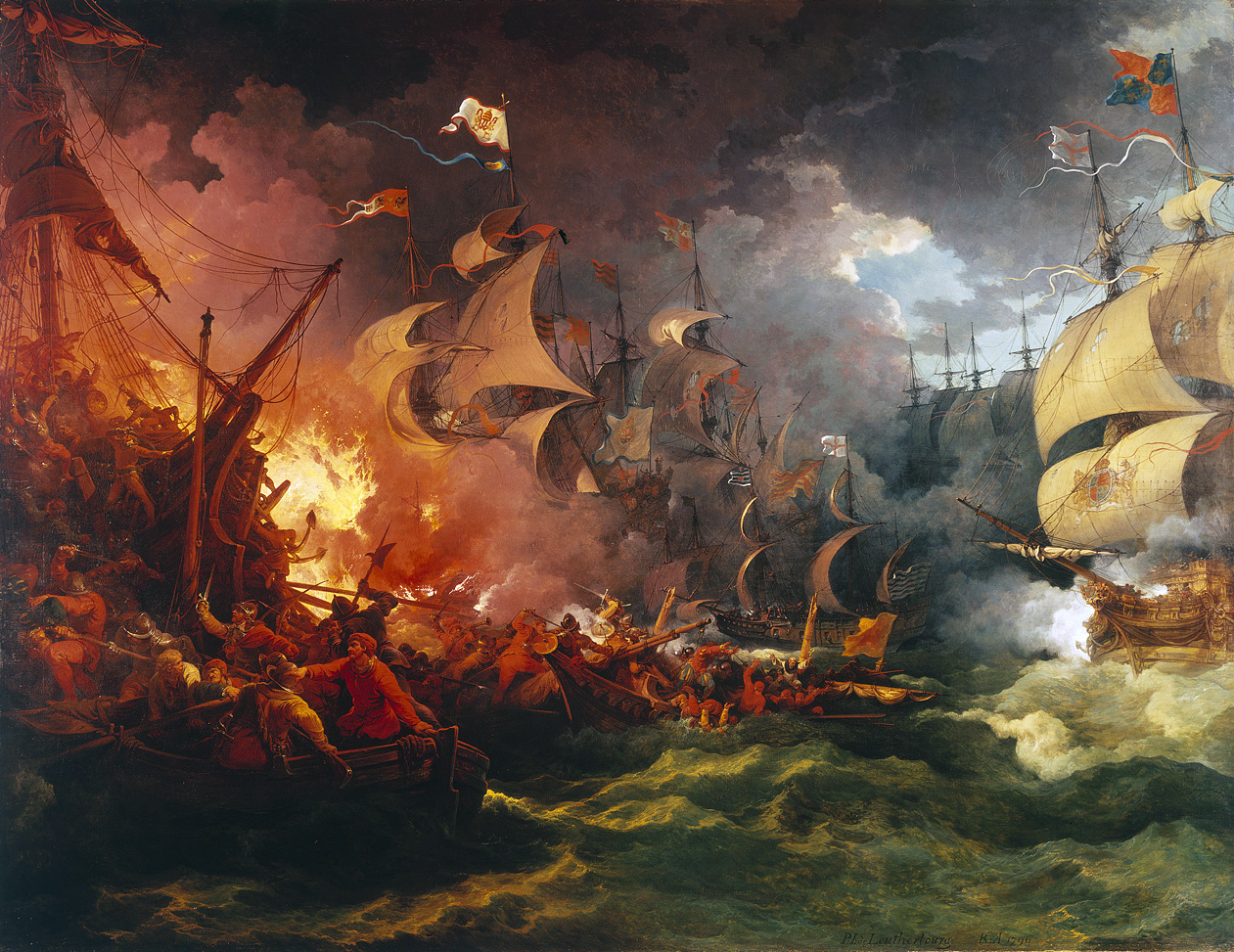
Drake and other English commanders attack the Armada off Plymouth, using longer-range gunnery while avoiding the close grappling combat favoured by Spain.
Medina Sidonia anchors the Armada off Calais while awaiting contact with Parma, creating the vulnerable concentration that the English exploit with fireships.
Howard sends fireships into the crowded Spanish anchorage at Calais, forcing Armada captains to cut their cables and scatter before Parma can embark his army.
Howard's fleet attacks the disordered Armada near Gravelines and inflicts severe damage, preventing the Spanish from restoring the formation needed to cover an invasion.
National thanksgiving services celebrate deliverance from the Spanish Armada and reinforce Protestant interpretations of Elizabethan national identity.
Norris reaches the outskirts of Lisbon, but the expected popular uprising fails to develop and the expedition lacks the support needed to take the capital.
Essex takes an English expeditionary force to Normandy to support Henry IV, reinforcing Protestant resistance to the Catholic League and its Spanish allies.
Essex's troops storm and occupy Cadiz after the fleet defeats Spanish shipping, inflicting severe losses before the expedition withdraws from the city.
Essex sails with a major Anglo-Dutch expedition against Cadiz, combining naval and land forces in a direct strike at Spain's Atlantic military infrastructure.
Padilla leads a new Spanish Armada intended for the British Isles, but severe Atlantic storms scatter the fleet before it can establish an invasion force.
Padilla commands another Spanish invasion fleet toward England, but storms again break up the expedition before its forces can achieve a coordinated landing.
Elizabeth's government mobilises troops and strengthens coastal readiness during a major invasion scare caused by reports that a Spanish fleet is approaching England.
Aguila lands a Spanish expeditionary army at Kinsale to support Irish rebels, opening the most serious Spanish military intervention in Elizabethan Ireland.
Mountjoy defeats the Irish relief army outside Kinsale, isolating the Spanish expedition and destroying the coalition's best chance of breaking the siege.
Aguila agrees terms to surrender Kinsale and other Spanish-held positions, ending the principal invasion attempt launched in support of the Irish rebellion.